Ch. 8 - Sequences, Induction, and Probability
Blitzer - College Algebra 8th Edition
Blitzer8th EditionCollege AlgebraISBN: 9780136970514Non è quello che usi tu?Cambia libro di testo
Capitolo 9, Problema 59

Let {an} = - 5, 10, - 20, 40, ..., {bn} = 10, - 5, - 20, - 35, ..., {cn} = - 2, 1, - 1/2, 1/4 Find the difference between the sum of the first 10 terms of {an} and the sum of the first 10 terms of {bn}.

Guida verificata passo dopo passo
1
Identify the sequences {a_n} and {b_n} and determine their types (arithmetic or geometric). For {a_n} = -5, 10, -20, 40, ..., observe the pattern of terms and check if there is a common ratio or common difference.
For {a_n}, calculate the common ratio \( r_a \) by dividing the second term by the first term: \( r_a = \frac{10}{-5} \). Verify if this ratio holds for subsequent terms to confirm it is geometric.
Similarly, analyze the sequence {b_n} = 10, -5, -20, -35, ... to determine if it is arithmetic or geometric. Calculate the differences between consecutive terms to check for a common difference \( d_b \).
Once the nature of both sequences is confirmed, use the appropriate formula to find the sum of the first 10 terms for each sequence. For a geometric sequence, use \( S_n = a_1 \frac{1 - r^n}{1 - r} \) where \( a_1 \) is the first term and \( r \) is the common ratio. For an arithmetic sequence, use \( S_n = \frac{n}{2} (2a_1 + (n-1)d) \) where \( d \) is the common difference.
Calculate the difference between the sum of the first 10 terms of {a_n} and the sum of the first 10 terms of {b_n} by subtracting \( S_{10}^{b} \) from \( S_{10}^{a} \).

Risposta video verificata per un problema simile:

Questa soluzione video è stata consigliata dai nostri tutor come utile per risolvere questo problema.
Durata del video:
8m

Concetti chiave

Ecco i concetti essenziali che devi comprendere per rispondere correttamente alla domanda.

Arithmetic and Geometric Sequences

Sequences are ordered lists of numbers following a specific pattern. Arithmetic sequences have a constant difference between terms, while geometric sequences have a constant ratio. Identifying the type helps determine the formula for the nth term and the sum of terms.
Video consigliato:
4:18
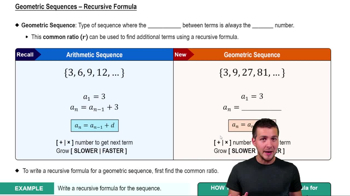
Geometric Sequences - Recursive Formula

Sum of the First n Terms of a Sequence

The sum of the first n terms of a sequence can be found using specific formulas. For arithmetic sequences, use S_n = n/2 (first term + last term). For geometric sequences, use S_n = a(1 - r^n)/(1 - r), where a is the first term and r is the common ratio.
Video consigliato:
8:22
Introduction to Sequences

Term-by-Term Operations on Sequences

When comparing sums of sequences, understanding how to perform operations like subtraction between sums is essential. This involves calculating each sum separately and then finding their difference, ensuring careful handling of signs and sequence types.
Video consigliato:
8:22
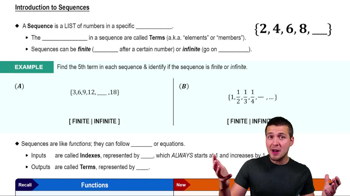
Introduction to Sequences