Ch. 8 - Sequences, Induction, and Probability
Blitzer - College Algebra 8th Edition
Blitzer8th EditionCollege AlgebraISBN: 9780136970514Non è quello che usi tu?Cambia libro di testo
Capitolo 9, Problema 82

Use a calculator's factorial key to evaluate each expression. (300/20)!

Guida verificata passo dopo passo
1
Identify the expression to evaluate: \(\left( \frac{300}{20} \right)!\).
Simplify the fraction inside the factorial: calculate \(\frac{300}{20}\).
Once simplified, rewrite the expression as \(n!\), where \(n\) is the result from the previous step.
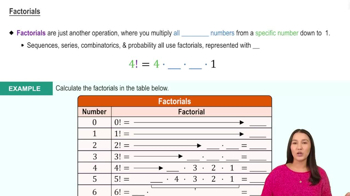
Recall that the factorial function \(n!\) means the product of all positive integers from 1 up to \(n\), i.e., \(n! = n \times (n-1) \times (n-2) \times \cdots \times 1\).
Use a calculator's factorial key to compute the value of \(n!\) based on the simplified integer \(n\).

Risposta video verificata per un problema simile:

Questa soluzione video è stata consigliata dai nostri tutor come utile per risolvere questo problema.
Durata del video:
1m

Concetti chiave

Ecco i concetti essenziali che devi comprendere per rispondere correttamente alla domanda.

Factorial Function

The factorial of a non-negative integer n, denoted n!, is the product of all positive integers from 1 to n. For example, 5! = 5 × 4 × 3 × 2 × 1 = 120. Factorials grow very quickly and are commonly used in permutations, combinations, and probability.
Video consigliato:
5:22
Factorials

Order of Operations

Order of operations dictates the sequence in which parts of a mathematical expression are evaluated. In the expression (300/20)!, you first perform the division inside the parentheses, then apply the factorial to the result. This ensures accurate calculation.
Video consigliato:
8:38
Performing Row Operations on Matrices

Using a Calculator's Factorial Key

Many scientific calculators have a factorial function, often labeled as 'n!'. To evaluate expressions like (300/20)!, you first compute the division, then use the factorial key on the resulting integer. This simplifies calculations of large factorials.
Video consigliato:
5:22
Factorials