Ch. 8 - Sequences, Induction, and Probability
Blitzer - College Algebra 8th Edition
Blitzer8th EditionCollege AlgebraISBN: 9780136970514Non è quello che usi tu?Cambia libro di testo
Capitolo 9, Problema 83

In Exercises 81–85, use a calculator's factorial key to evaluate each expression.
20!300\(\frac{20!}{300}\)

Guida verificata passo dopo passo
1
Recognize that the expression involves the factorial of 20, written as 20!, which means the product of all positive integers from 1 to 20.
Understand that the expression to evaluate is 20!300, which means you need to divide the factorial of 20 by 300.
Use a calculator with a factorial function to compute 20!. This will give you a very large number since factorials grow rapidly.
After finding the value of 20!, perform the division by 300 to simplify the expression.
Write the final answer as the quotient of 20! divided by 300, which completes the evaluation.

Risposta video verificata per un problema simile:

Questa soluzione video è stata consigliata dai nostri tutor come utile per risolvere questo problema.
Durata del video:
1m

Concetti chiave

Ecco i concetti essenziali che devi comprendere per rispondere correttamente alla domanda.

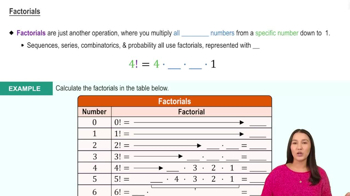
Factorials

A factorial, denoted by n!, is the product of all positive integers from 1 up to n. For example, 5! = 5 × 4 × 3 × 2 × 1 = 120. Factorials grow very quickly and are commonly used in permutations, combinations, and probability.
Video consigliato:
5:22
Factorials

Using a Calculator's Factorial Function

Many scientific calculators have a factorial key (!) that allows quick computation of factorial values without manual multiplication. To evaluate expressions like 20!, you input 20 and then press the factorial key, which returns the exact or approximate value.
Video consigliato:
5:22
Factorials

Simplifying Factorial Expressions

When dividing factorials or factorials by numbers, it’s important to understand how to simplify the expression. For example, 20!/300 means calculating 20! first, then dividing by 300. Recognizing when to simplify before calculating can save time and reduce errors.
Video consigliato:
5:22
Factorials