Ch. P - Fundamental Concepts of Algebra
Blitzer - College Algebra 8th Edition
Blitzer8th EditionCollege AlgebraISBN: 9780136970514Non è quello che usi tu?Cambia libro di testo
Capitolo 1, Problema 65

Evaluate each expression 1251/3.

Guida verificata passo dopo passo
1
Recognize that the expression involves a negative fractional exponent: \(125^{\left(-\frac{1}{3}\right)}\).
Recall the rule for negative exponents: \(a^{-n} = \frac{1}{a^n}\). Apply this to rewrite the expression as \(\frac{1}{125^{\frac{1}{3}}}\).
Understand that the fractional exponent \(\frac{1}{3}\) represents the cube root, so rewrite the denominator as \(\sqrt[3]{125}\).
Evaluate the cube root of 125 by finding the number which, when cubed, equals 125.
Write the final expression as \(\frac{1}{\sqrt[3]{125}}\) and simplify further if possible.

Risposta video verificata per un problema simile:

Questa soluzione video è stata consigliata dai nostri tutor come utile per risolvere questo problema.
Durata del video:
1m

Concetti chiave

Ecco i concetti essenziali che devi comprendere per rispondere correttamente alla domanda.

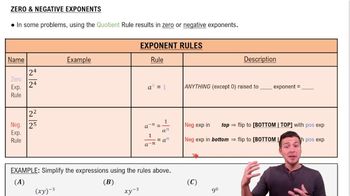
Negative Exponents

A negative exponent indicates the reciprocal of the base raised to the corresponding positive exponent. For example, a^(-n) equals 1 divided by a^n. This concept allows us to rewrite expressions with negative powers into fractions.
Video consigliato:
6:37
Zero and Negative Rules

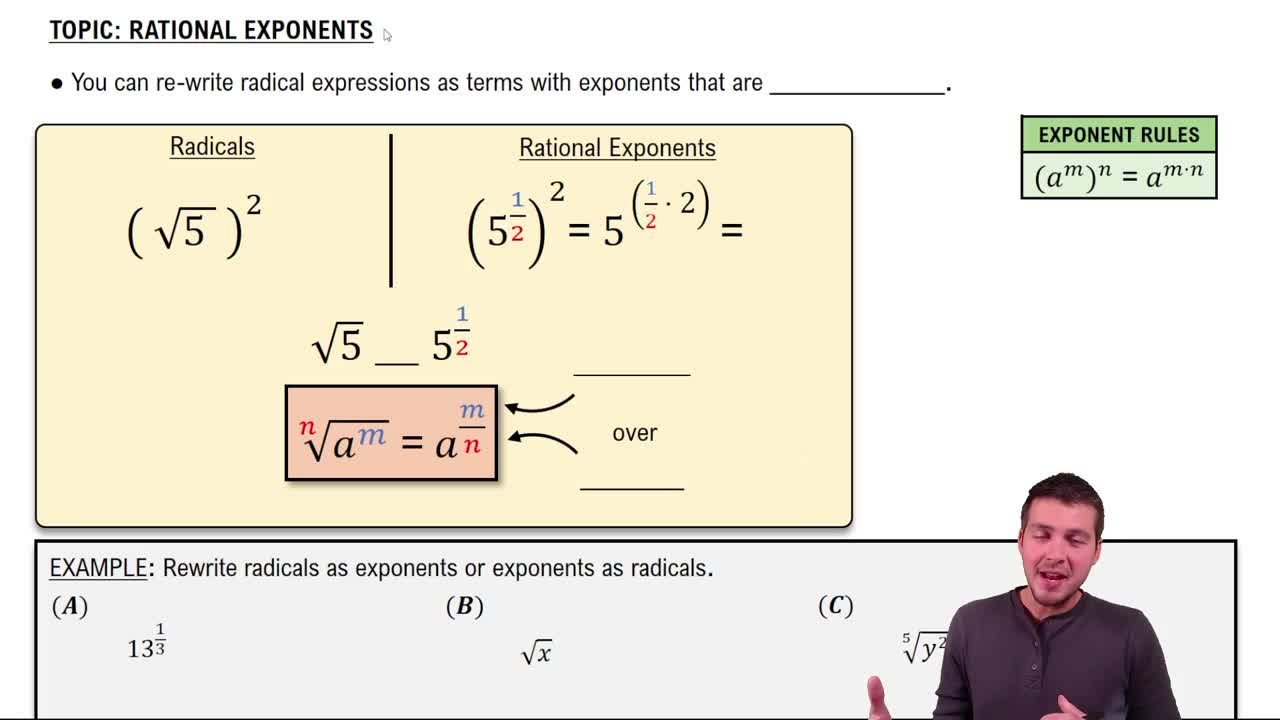
Fractional Exponents

Fractional exponents represent roots and powers simultaneously. Specifically, a^(m/n) means the n-th root of a raised to the m-th power, or equivalently, (a^(1/n))^m. This helps in simplifying expressions involving roots and powers.
Video consigliato:
04:06
Rational Exponents

Evaluating Cube Roots

The cube root of a number is a value that, when multiplied by itself three times, gives the original number. For example, the cube root of 125 is 5 because 5^3 = 125. Understanding cube roots is essential for simplifying expressions with fractional exponents like 1/3.
Video consigliato:
02:20
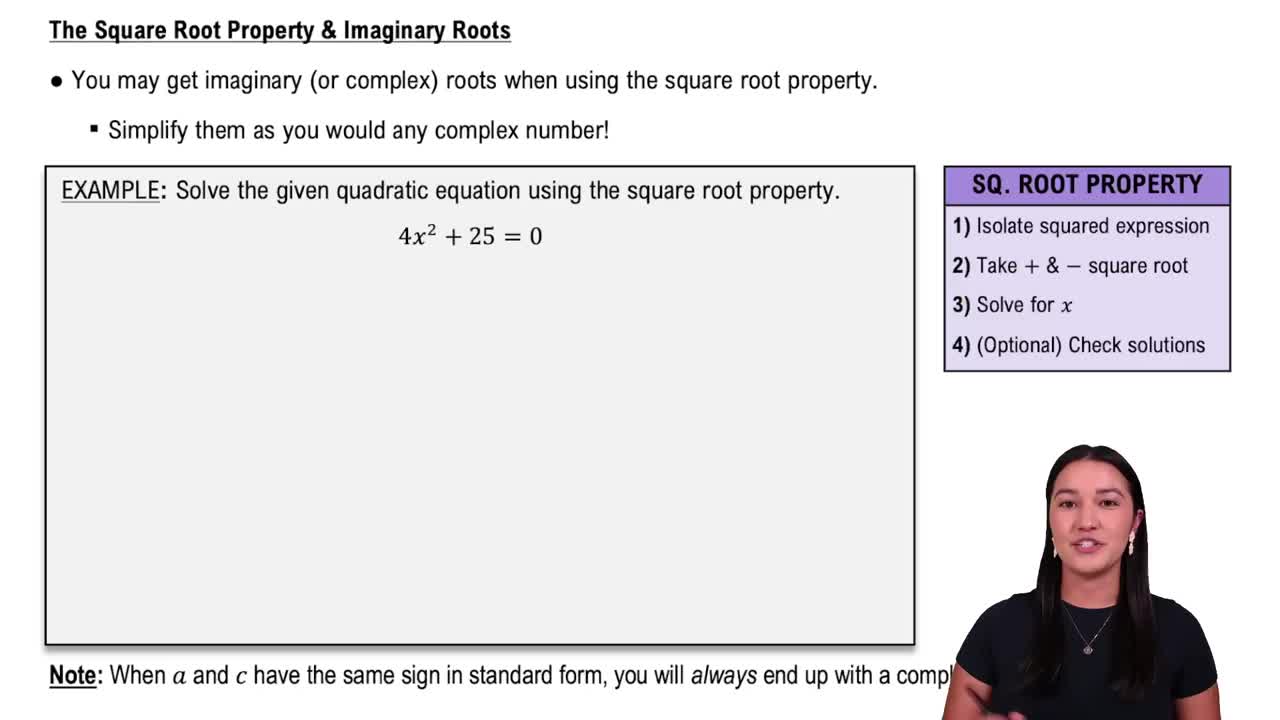
Imaginary Roots with the Square Root Property