Ch. P - Fundamental Concepts of Algebra
Blitzer - College Algebra 8th Edition
Blitzer8th EditionCollege AlgebraISBN: 9780136970514Non è quello che usi tu?Cambia libro di testo
Capitolo 1, Problema 66

Evaluate each expression in Exercises 55–66, or indicate that the root is not a real number. 1646\(\sqrt\)[6]{\(\frac{1}{64}\)}

Guida verificata passo dopo passo
1
Identify the expression to evaluate: the sixth root of \( \frac{1}{64} \), which can be written as \( \sqrt[6]{\frac{1}{64}} \).
Recall that the nth root of a number \( a \) can be expressed as \( a^{\frac{1}{n}} \). So, rewrite the expression as \( \left( \frac{1}{64} \right)^{\frac{1}{6}} \).
Express the denominator 64 as a power of a base number. Since \( 64 = 2^6 \), rewrite the expression as \( \left( \frac{1}{2^6} \right)^{\frac{1}{6}} \).
Apply the power of a power rule \( (a^m)^n = a^{m \times n} \) to simplify the expression: \( \left( 2^{-6} \right)^{\frac{1}{6}} = 2^{-6 \times \frac{1}{6}} \).
Simplify the exponent multiplication to get \( 2^{-1} \), which is the same as \( \frac{1}{2} \). This is the simplified form of the original expression.

Risposta video verificata per un problema simile:

Questa soluzione video è stata consigliata dai nostri tutor come utile per risolvere questo problema.
Durata del video:
3m

Concetti chiave

Ecco i concetti essenziali che devi comprendere per rispondere correttamente alla domanda.

Radical Expressions and Roots

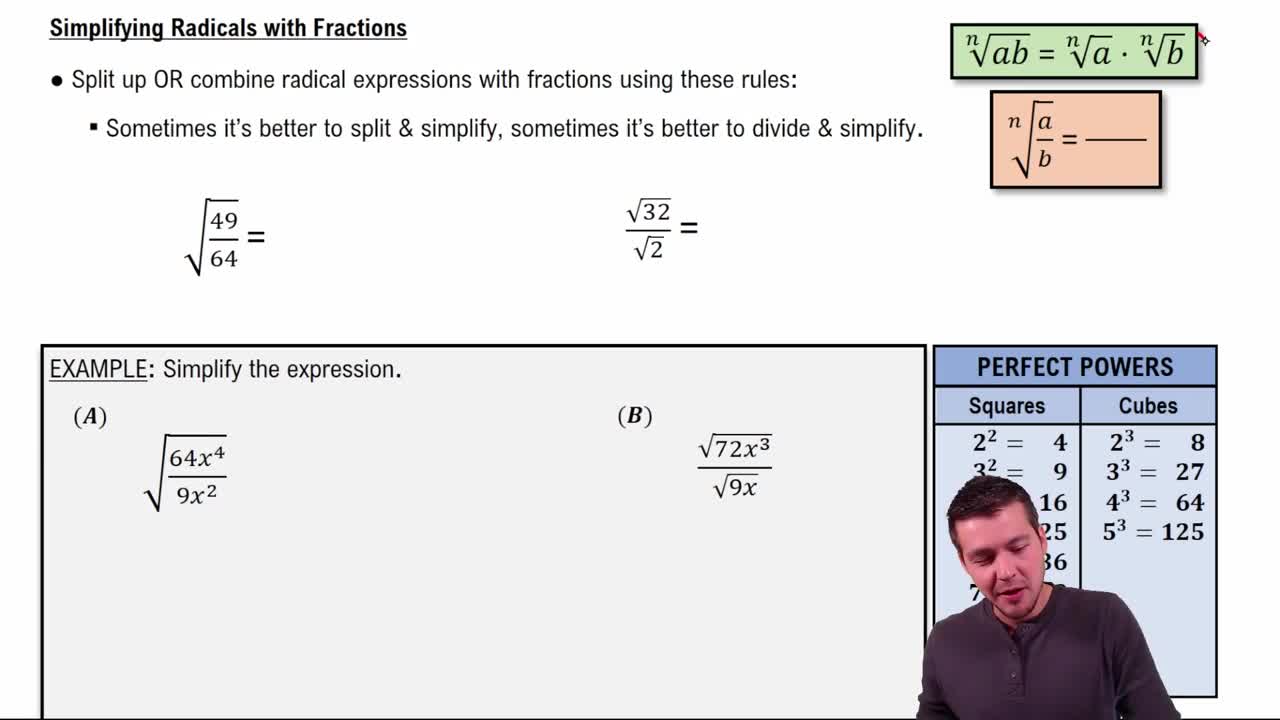
Radical expressions involve roots such as square roots, cube roots, and higher-order roots. The notation ⁿ√a represents the nth root of a number a, which is the value that, when raised to the nth power, equals a. Understanding how to interpret and simplify these roots is essential for evaluating expressions like ⁶√(1/64).
Video consigliato:
05:45
Radical Expressions with Fractions

Properties of Exponents

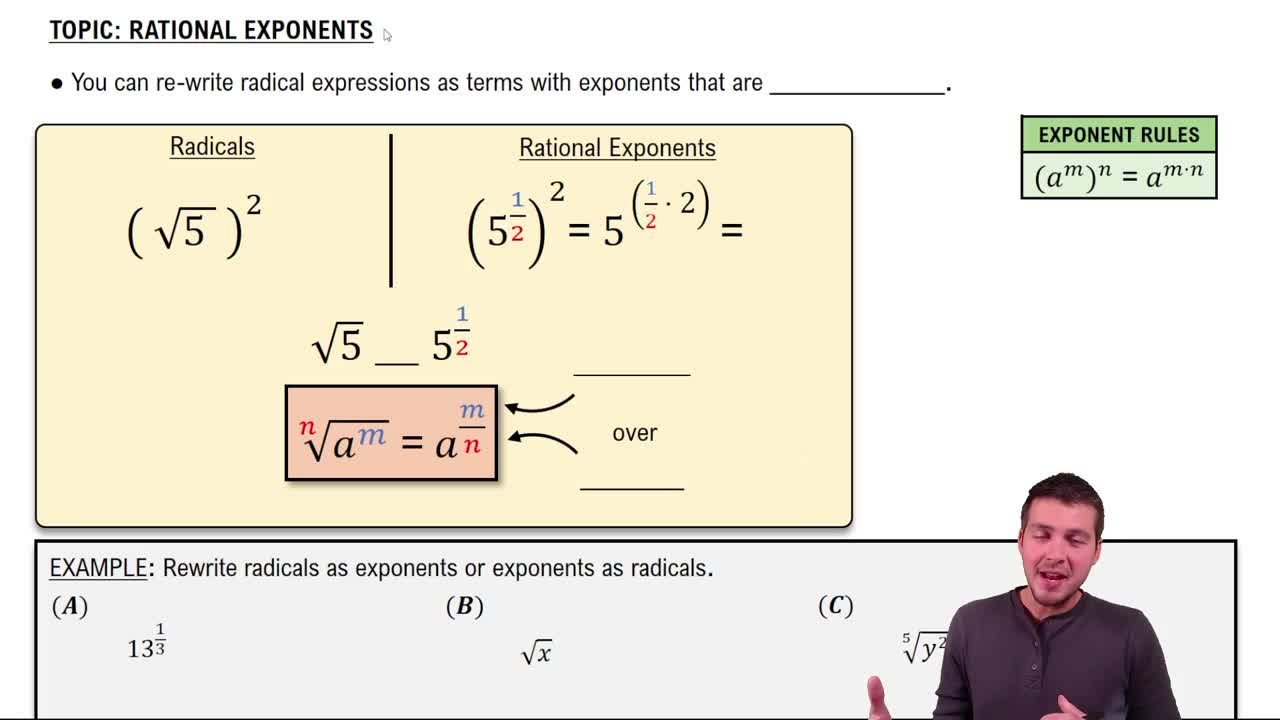
Roots can be expressed using fractional exponents, where ⁿ√a equals a^(1/n). This allows the use of exponent rules to simplify expressions. For example, ⁶√(1/64) can be rewritten as (1/64)^(1/6), facilitating easier calculation by breaking down the base and applying exponent rules.
Video consigliato:
04:06
Rational Exponents

Real vs. Non-Real Roots

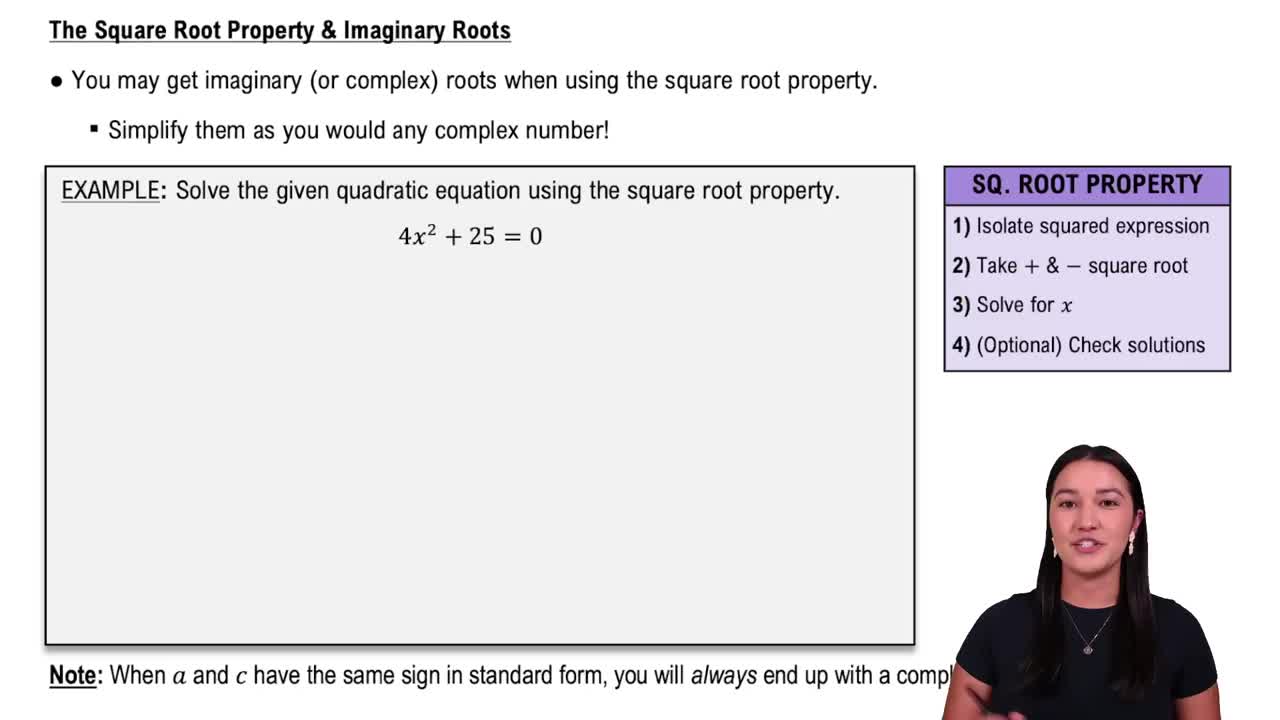
Not all roots yield real numbers; some may be complex or imaginary. For even roots, the radicand (the number inside the root) must be non-negative to have a real root. Since 1/64 is positive, its sixth root is real, but recognizing when roots are not real is important for correctly answering such questions.
Video consigliato:
02:20
Imaginary Roots with the Square Root Property