Ch. P - Fundamental Concepts of Algebra
Blitzer - College Algebra 8th Edition
Blitzer8th EditionCollege AlgebraISBN: 9780136970514Non è quello che usi tu?Cambia libro di testo
Capitolo 1, Problema 59

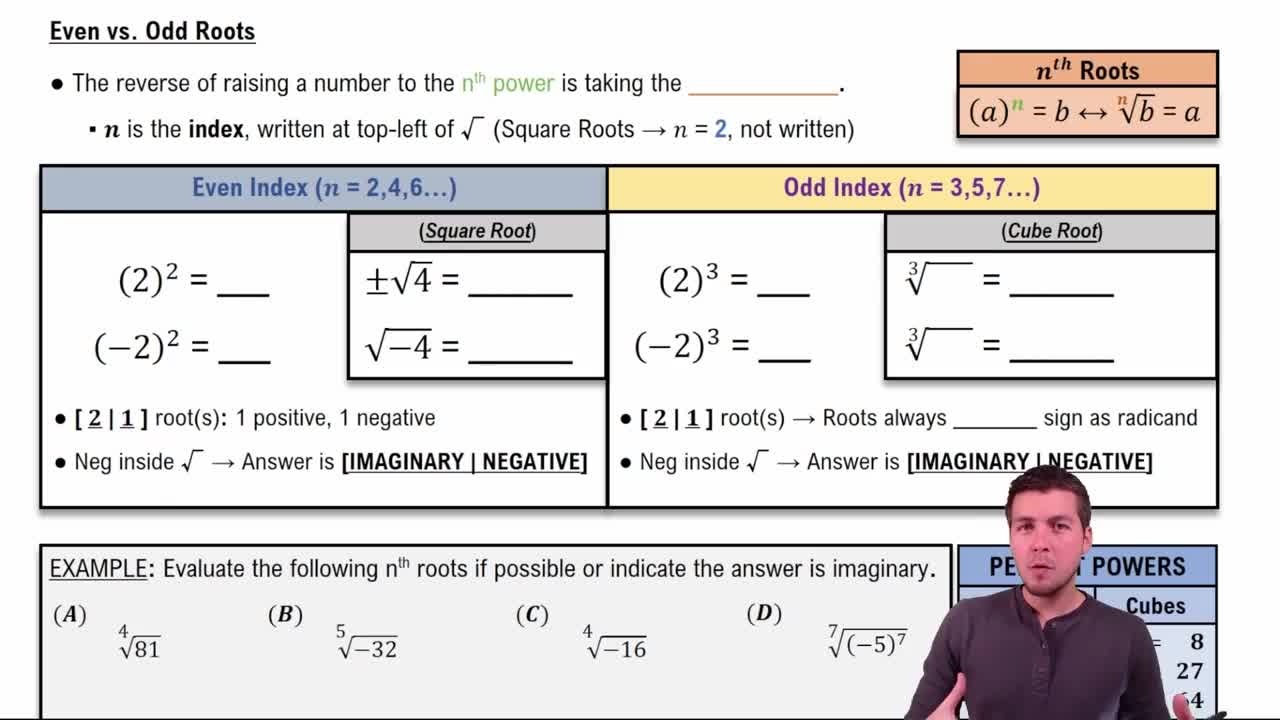
Evaluate each expression in Exercises 55–66, or indicate that the root is not a real number. −164\(\sqrt\)[4]{-16}

Guida verificata passo dopo passo
1
Identify the expression: you need to evaluate the fourth root of -16, which is written as \(\sqrt[4]{-16}\).
Recall the definition of the fourth root: \(\sqrt[4]{a}\) means the number which, when raised to the power 4, equals \(a\).
Consider the nature of the root: since the root is even (4th root), the radicand (the number inside the root) must be non-negative for the root to be a real number.
Check if \(-16\) is non-negative: since \(-16\) is negative, the fourth root of \(-16\) is not a real number in the set of real numbers.
Conclude that the expression \(\sqrt[4]{-16}\) does not have a real value, but it can be expressed in terms of complex numbers if needed.

Risposta video verificata per un problema simile:

Questa soluzione video è stata consigliata dai nostri tutor come utile per risolvere questo problema.
Durata del video:
1m

Concetti chiave

Ecco i concetti essenziali che devi comprendere per rispondere correttamente alla domanda.

Nth Roots and Radicals

The nth root of a number is a value that, when raised to the nth power, equals the original number. For example, the fourth root of 16 is 2 because 2⁴ = 16. Understanding how to evaluate roots, especially even roots like square or fourth roots, is essential for solving such expressions.
Video consigliato:
06:56
Nth Roots

Real vs. Complex Numbers

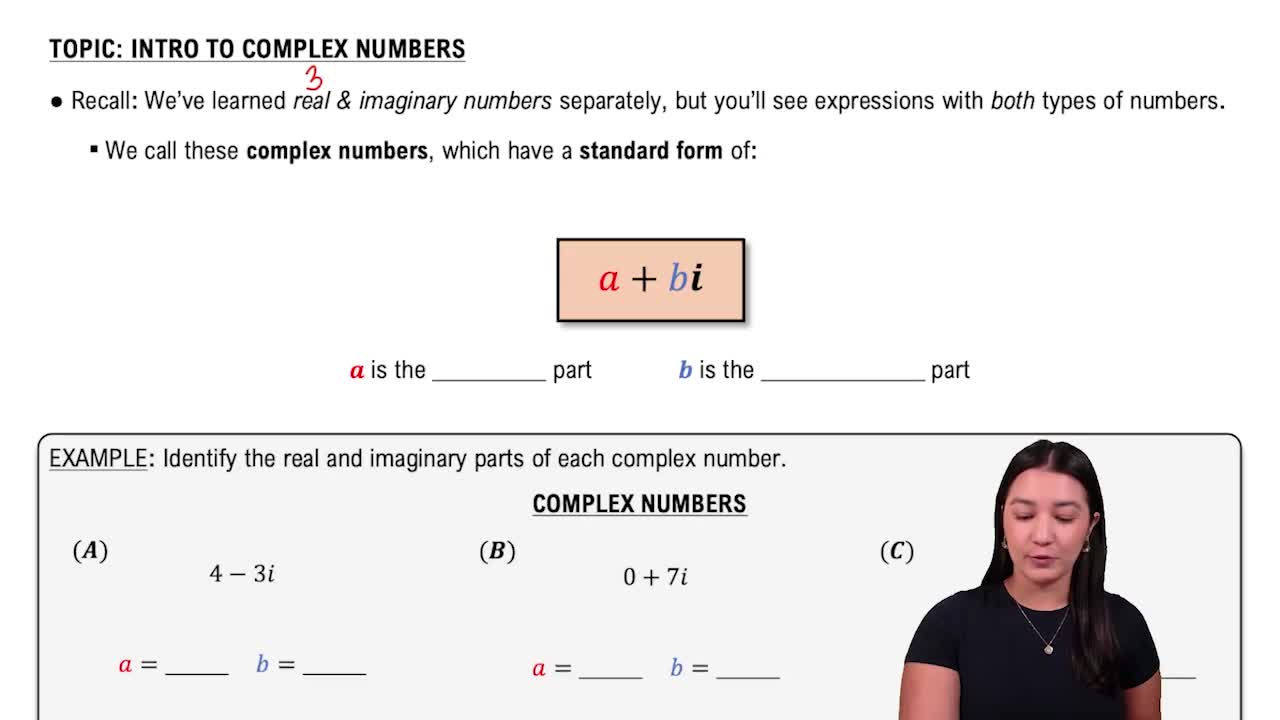
Not all roots of negative numbers are real. Even roots (like square or fourth roots) of negative numbers do not have real solutions because no real number raised to an even power results in a negative number. Recognizing when roots are real or complex helps determine if the expression has a real solution.
Video consigliato:
03:31
Introduction to Complex Numbers

Properties of Exponents and Negative Numbers

Raising negative numbers to powers depends on whether the exponent is even or odd. An odd power of a negative number remains negative, while an even power becomes positive. This property is crucial when evaluating roots and understanding why certain roots of negative numbers are not real.
Video consigliato:
4:47
The Number e