Ch. P - Fundamental Concepts of Algebra
Blitzer - College Algebra 8th Edition
Blitzer8th EditionCollege AlgebraISBN: 9780136970514Non è quello che usi tu?Cambia libro di testo
Capitolo 1, Problema 15

In Exercises 1–16, evaluate each algebraic expression for the given value or values of the variable(s). (2x+3y)/(x+1), for x=-2 and y=4

Guida verificata passo dopo passo
1
Step 1: Begin by substituting the given values of the variables into the algebraic expression. Replace x with -2 and y with 4 in the expression \((2x + 3y) / (x + 1)\).
Step 2: Substitute the values into the numerator \(2x + 3y\). This becomes \(2(-2) + 3(4)\).
Step 3: Substitute the value of x into the denominator \(x + 1\). This becomes \((-2) + 1\).
Step 4: Simplify the numerator \(2(-2) + 3(4)\) by performing the multiplication and addition operations.
Step 5: Simplify the denominator \((-2) + 1\) by performing the addition operation. Combine the simplified numerator and denominator to form the final fraction.

Risposta video verificata per un problema simile:

Questa soluzione video è stata consigliata dai nostri tutor come utile per risolvere questo problema.
Durata del video:
2m

Concetti chiave

Ecco i concetti essenziali che devi comprendere per rispondere correttamente alla domanda.

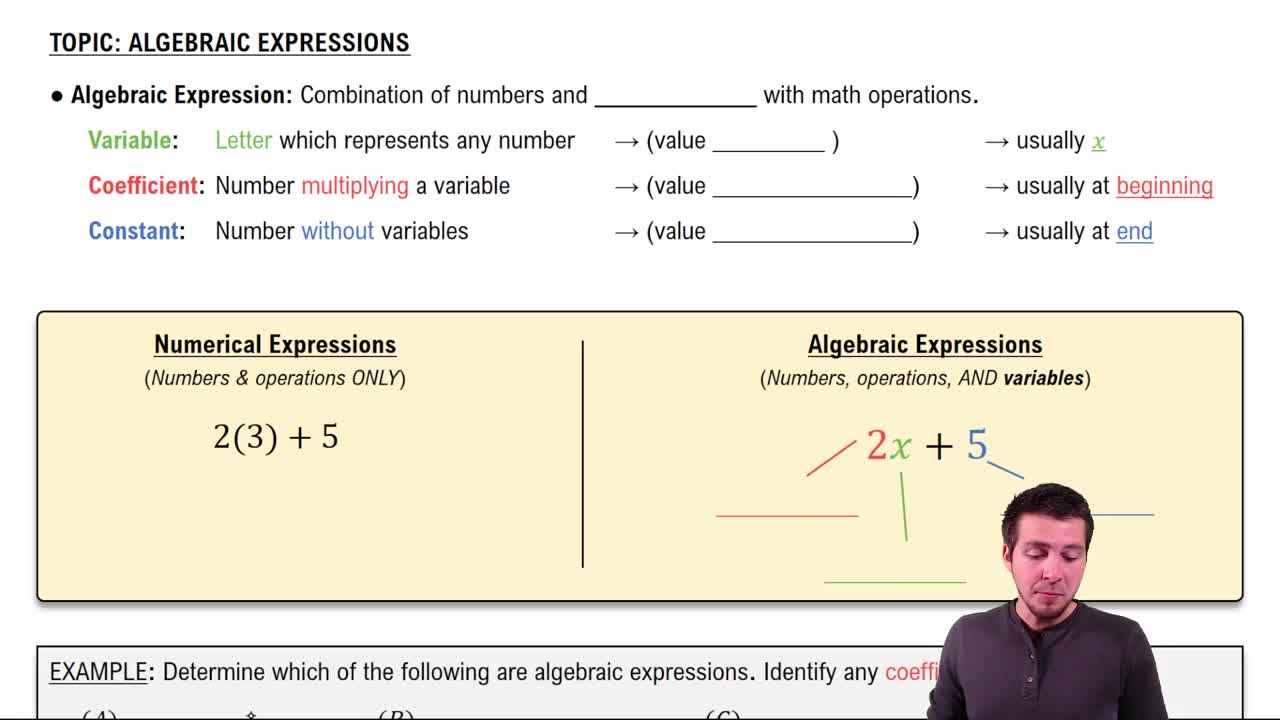
Algebraic Expressions

An algebraic expression is a mathematical phrase that can include numbers, variables, and operation symbols. In this case, the expression (2x + 3y) / (x + 1) combines both variables and constants, and understanding how to manipulate these expressions is crucial for evaluation.
Video consigliato:
05:09
Introduction to Algebraic Expressions

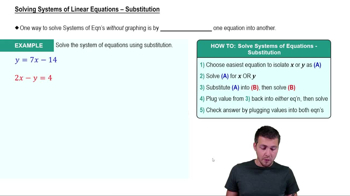
Substitution

Substitution is the process of replacing variables in an expression with their corresponding numerical values. For the given expression, substituting x = -2 and y = 4 allows us to simplify the expression into a numerical form, which is essential for evaluating the expression correctly.
Video consigliato:
5:48
Solving Systems of Equations - Substitution

Order of Operations

The order of operations is a set of rules that dictates the sequence in which calculations are performed in an expression. It is commonly remembered by the acronym PEMDAS (Parentheses, Exponents, Multiplication and Division, Addition and Subtraction). Following this order ensures that the evaluation of the expression yields the correct result.
Video consigliato:
8:38
Performing Row Operations on Matrices