Ch. P - Fundamental Concepts of Algebra
Blitzer - College Algebra 8th Edition
Blitzer8th EditionCollege AlgebraISBN: 9780136970514Non è quello che usi tu?Cambia libro di testo
Capitolo 1, Problema 15

In Exercises 15–58, find each product. (x+1)(x2−x+1)

Guida verificata passo dopo passo
1
Step 1: Recognize that the problem involves multiplying two polynomials: \((x + 1)\) and \((x^2 - x + 1)\). This requires the distributive property (also known as the FOIL method for binomials).
Step 2: Distribute the first term of \((x + 1)\), which is \(x\), to each term in \((x^2 - x + 1)\). This gives: \(x \cdot x^2 + x \cdot (-x) + x \cdot 1\).
Step 3: Simplify the terms from Step 2: \(x \cdot x^2 = x^3\), \(x \cdot (-x) = -x^2\), and \(x \cdot 1 = x\). Combine these to get \(x^3 - x^2 + x\).
Step 4: Distribute the second term of \((x + 1)\), which is \(1\), to each term in \((x^2 - x + 1)\). This gives: \(1 \cdot x^2 + 1 \cdot (-x) + 1 \cdot 1\).
Step 5: Simplify the terms from Step 4: \(1 \cdot x^2 = x^2\), \(1 \cdot (-x) = -x\), and \(1 \cdot 1 = 1\). Combine these to get \(x^2 - x + 1\). Finally, add the results from Step 3 and Step 5 to combine like terms.

Risposta video verificata per un problema simile:

Questa soluzione video è stata consigliata dai nostri tutor come utile per risolvere questo problema.
Durata del video:
4m

Concetti chiave

Ecco i concetti essenziali che devi comprendere per rispondere correttamente alla domanda.

Polynomial Multiplication

Polynomial multiplication involves distributing each term of one polynomial to every term of another polynomial. In this case, we will apply the distributive property to multiply the binomial (x + 1) with the trinomial (x^2 - x + 1), ensuring that each term in the first polynomial is multiplied by each term in the second.
Video consigliato:
03:42
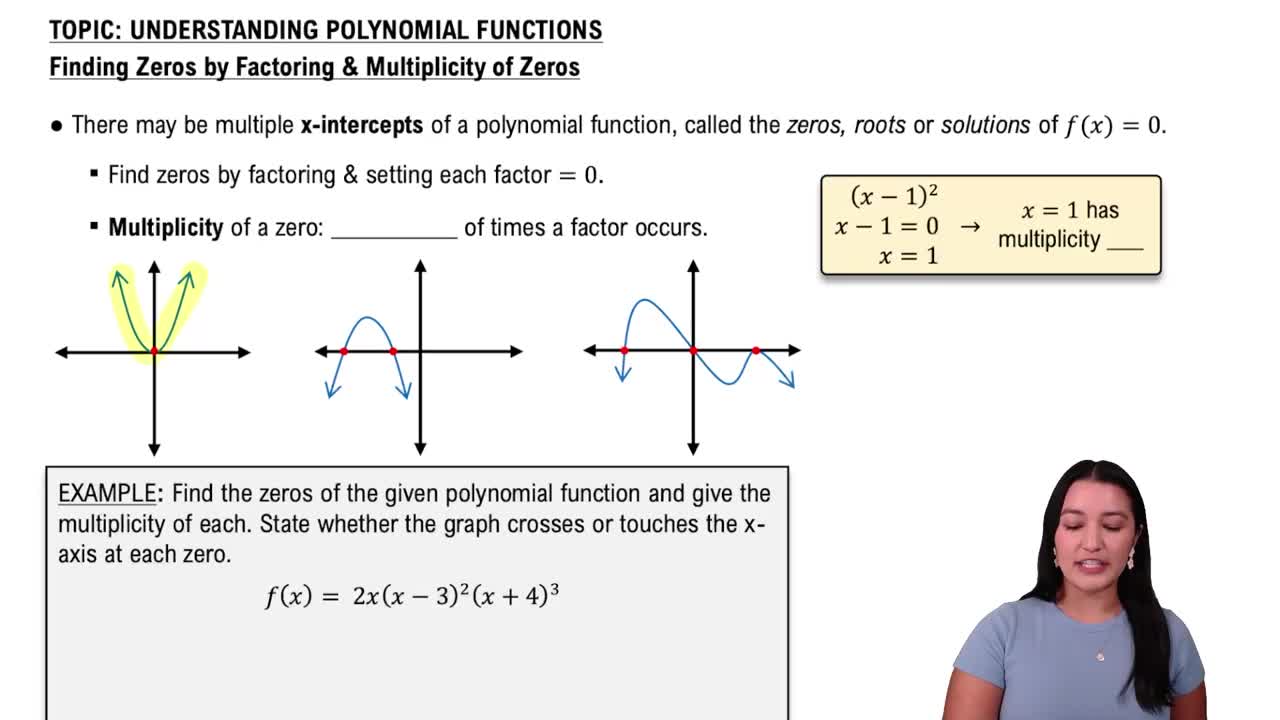
Finding Zeros & Their Multiplicity

Combining Like Terms

After multiplying polynomials, the next step is to combine like terms, which are terms that have the same variable raised to the same power. This process simplifies the expression into a standard polynomial form, making it easier to analyze or further manipulate.
Video consigliato:
5:22
Combinations

Standard Form of a Polynomial

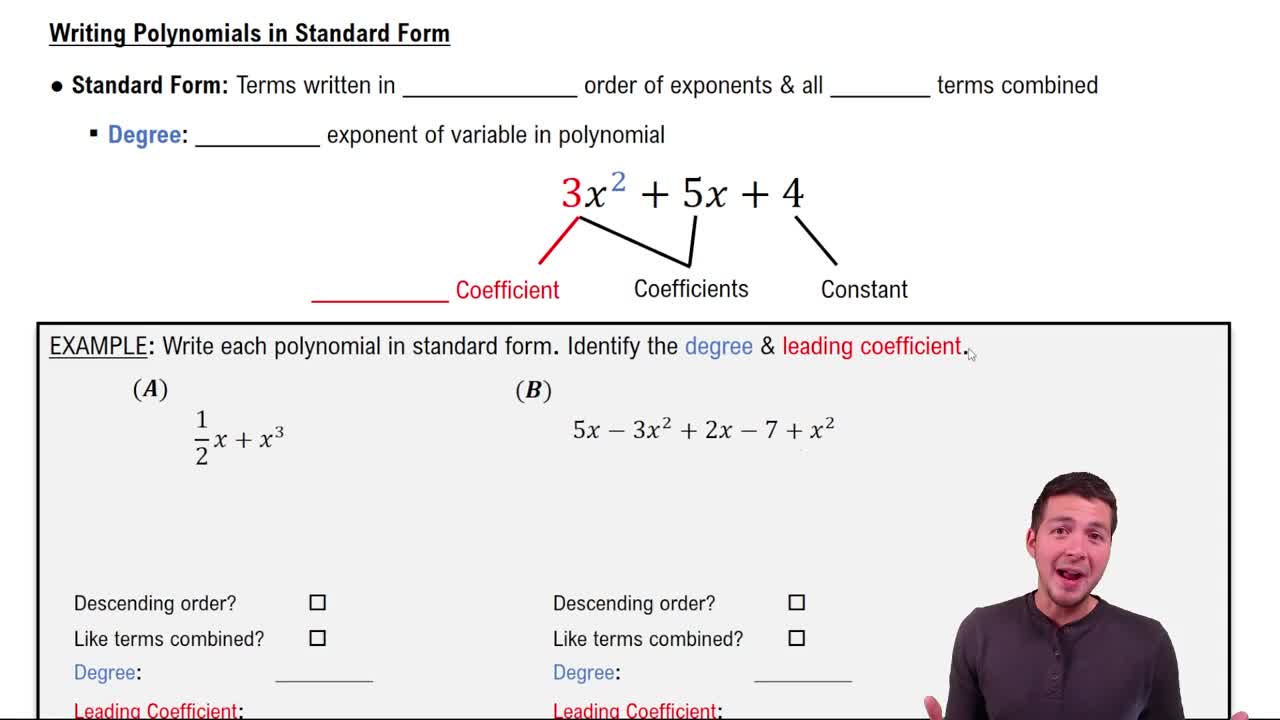
The standard form of a polynomial is expressed in descending order of the powers of the variable. For example, a polynomial like 2x^3 + 3x^2 + x + 5 is in standard form. Writing the final product in standard form helps in understanding the polynomial's degree and leading coefficient.
Video consigliato:
05:16
Standard Form of Polynomials