Ch. P - Fundamental Concepts of Algebra
Blitzer - College Algebra 8th Edition
Blitzer8th EditionCollege AlgebraISBN: 9780136970514Non è quello che usi tu?Cambia libro di testo
Capitolo 1, Problema 109

In Exercises 103–110, insert either <, >, or = in the shaded area to make a true statement. 8/13÷8/13 □ |−1|

Guida verificata passo dopo passo
1
Step 1: Simplify the left-hand side of the inequality. The expression is \( \frac{8}{13} \div \frac{8}{13} \). Recall that dividing fractions involves multiplying by the reciprocal of the second fraction. This means \( \frac{8}{13} \div \frac{8}{13} = \frac{8}{13} \times \frac{13}{8} \).
Step 2: Multiply the numerators and denominators of the fractions. \( \frac{8}{13} \times \frac{13}{8} = \frac{8 \cdot 13}{13 \cdot 8} \). Simplify the fraction by canceling out the common terms in the numerator and denominator, which results in \( 1 \).
Step 3: Simplify the right-hand side of the inequality. The expression is \( | -1 | \), which represents the absolute value of \( -1 \). Recall that the absolute value of a number is its distance from zero on the number line, so \( | -1 | = 1 \).
Step 4: Compare the simplified left-hand side and right-hand side. The left-hand side is \( 1 \), and the right-hand side is also \( 1 \).
Step 5: Insert the appropriate symbol (\( = \)) in the shaded area to make the statement true. The final inequality is \( \frac{8}{13} \div \frac{8}{13} = | -1 | \).

Risposta video verificata per un problema simile:

Questa soluzione video è stata consigliata dai nostri tutor come utile per risolvere questo problema.
Durata del video:
6m

Concetti chiave

Ecco i concetti essenziali che devi comprendere per rispondere correttamente alla domanda.

Division of Fractions

To divide fractions, you multiply the first fraction by the reciprocal of the second. In this case, 8/13 ÷ 8/13 simplifies to 8/13 × 13/8, which equals 1. Understanding this operation is crucial for evaluating the expression correctly.
Video consigliato:
05:45
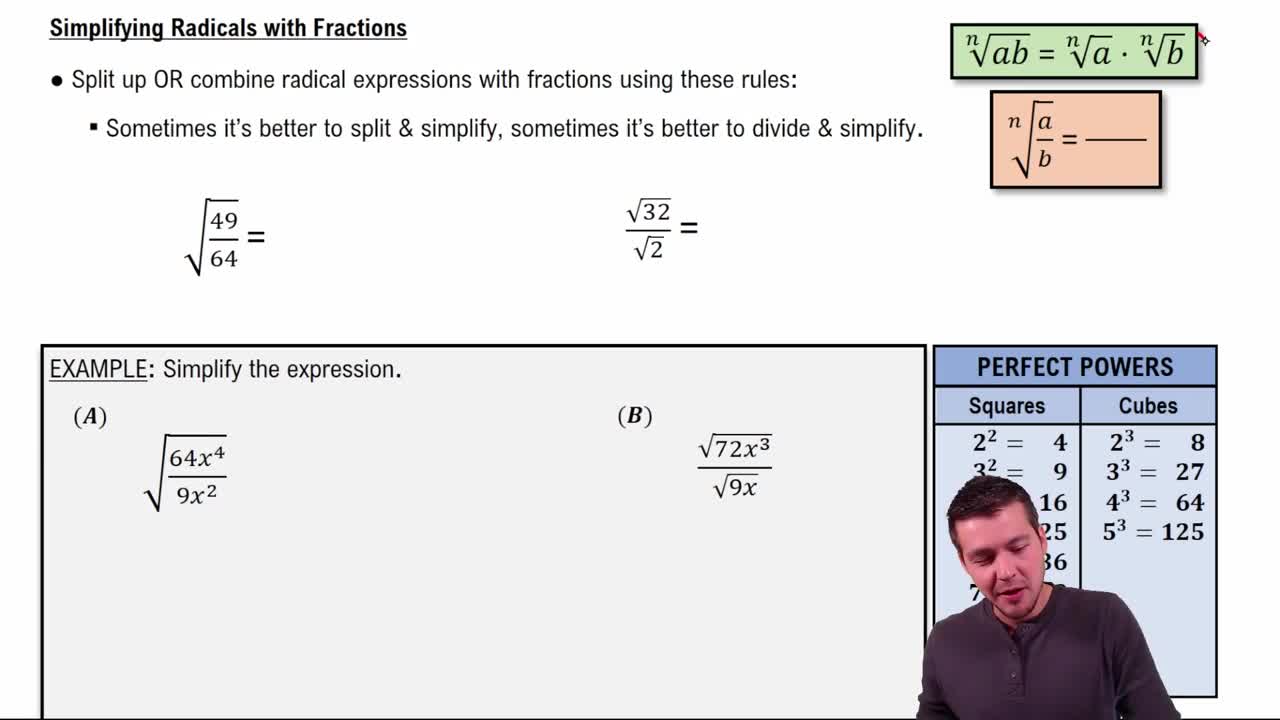
Radical Expressions with Fractions

Absolute Value

The absolute value of a number is its distance from zero on the number line, regardless of direction. For example, |−1| equals 1. Recognizing how absolute values work is essential for comparing the results of the division with the absolute value in the expression.
Video consigliato:
7:12
Parabolas as Conic Sections Example 1

Inequality Symbols

Inequality symbols (<, >, =) are used to compare two values. Understanding how to interpret these symbols is vital for determining the correct relationship between the results of the division and the absolute value, allowing you to fill in the shaded area accurately.
Video consigliato:
06:07
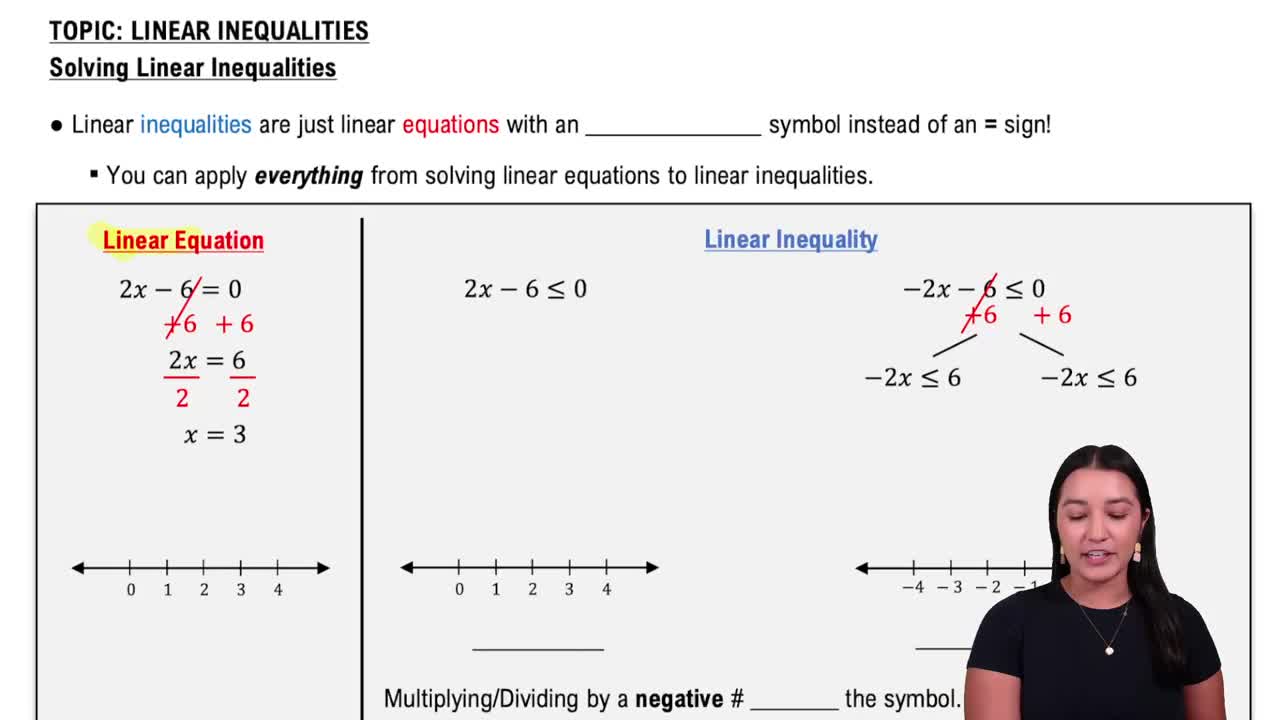
Linear Inequalities