Ch. P - Fundamental Concepts of Algebra
Blitzer - College Algebra 8th Edition
Blitzer8th EditionCollege AlgebraISBN: 9780136970514Non è quello che usi tu?Cambia libro di testo
Capitolo 1, Problema 111

In Exercises 107–114, simplify each exponential expression. Assume that variables represent nonzero real numbers. (3x−4 y z−7)(3x)−3

Guida verificata passo dopo passo
1
Rewrite the given expression: \((3x^{-4}y z^{-7})(3x)^{-3}\). Start by separating the terms and grouping the coefficients and variables for clarity.
Apply the property of exponents \(a^m a^n = a^{m+n}\) to combine like bases. For the base \(3\), combine \(3\) from the first term and \(3^{-3}\) from the second term.
For the variable \(x\), combine the exponents \(-4\) from the first term and \(-3\) from the second term using the same property of exponents.
The variables \(y\) and \(z\) are not present in the second term, so their exponents remain unchanged. Specifically, \(y\) has an exponent of \(1\), and \(z\) has an exponent of \(-7\).
Simplify the resulting expression by combining all terms and writing the final expression in simplified form, ensuring all exponents are combined correctly.

Risposta video verificata per un problema simile:

Questa soluzione video è stata consigliata dai nostri tutor come utile per risolvere questo problema.
Durata del video:
3m

Concetti chiave

Ecco i concetti essenziali che devi comprendere per rispondere correttamente alla domanda.

Exponential Rules

Exponential rules are fundamental properties that govern the manipulation of expressions involving exponents. Key rules include the product of powers (a^m * a^n = a^(m+n)), the power of a power ( (a^m)^n = a^(m*n)), and the power of a product ( (ab)^n = a^n * b^n). Understanding these rules is essential for simplifying expressions with exponents.
Video consigliato:
6:54
Cramer's Rule - 2 Equations with 2 Unknowns

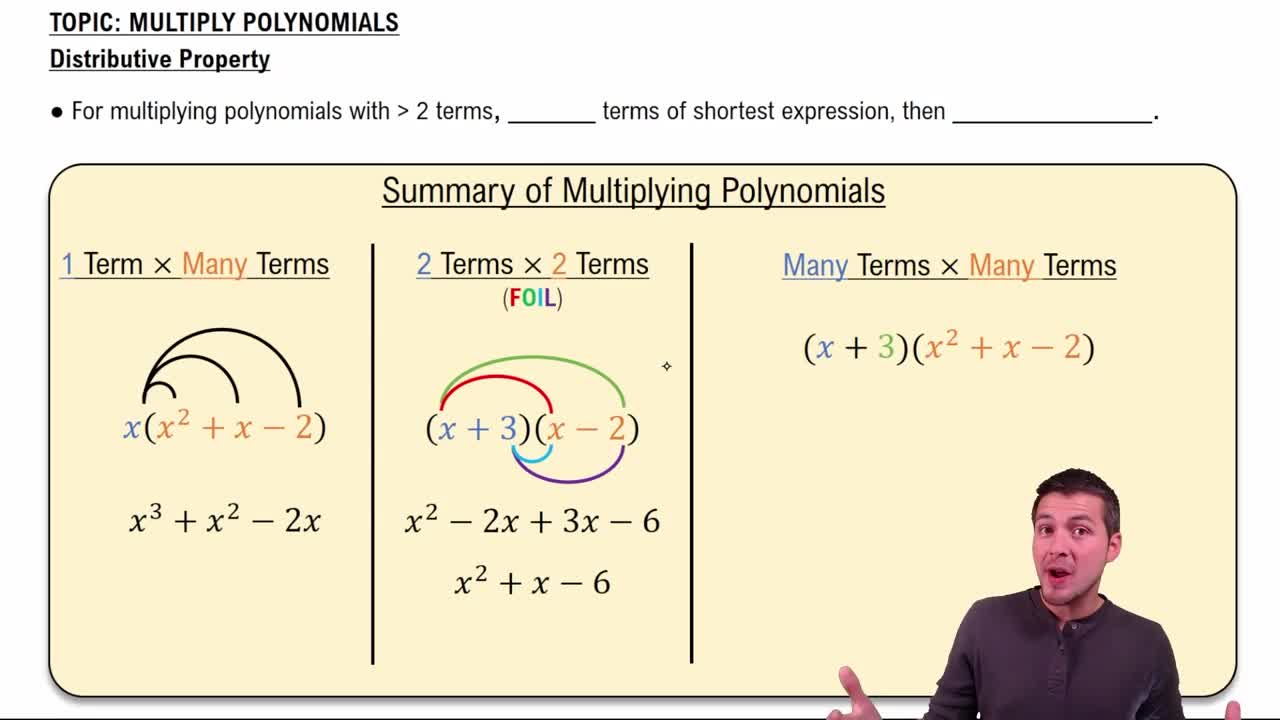
Distributive Property

The distributive property states that a(b + c) = ab + ac, allowing us to multiply a single term by two or more terms inside a parenthesis. This property is crucial when simplifying expressions, especially when dealing with products of sums or differences. It helps in breaking down complex expressions into simpler components for easier manipulation.
Video consigliato:
04:15
Multiply Polynomials Using the Distributive Property

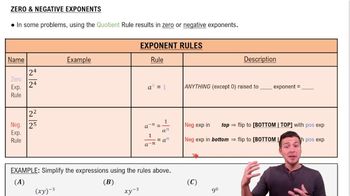
Negative Exponents

Negative exponents indicate the reciprocal of the base raised to the opposite positive exponent, expressed as a^(-n) = 1/(a^n). This concept is vital when simplifying expressions that contain negative exponents, as it allows for the transformation of terms into a more manageable form, often leading to a clearer final expression.
Video consigliato:
6:37
Zero and Negative Rules