Ch. P - Fundamental Concepts of Algebra
Blitzer - College Algebra 8th Edition
Blitzer8th EditionCollege AlgebraISBN: 9780136970514Non è quello che usi tu?Cambia libro di testo
Capitolo 1, Problema 58

Simplify each exponential expression in Exercises 23–64. 10x4y930x12y−3\(\frac{10x^4 y^9}{30x^{12}\) y^{-3}}

Guida verificata passo dopo passo
1
Start by writing the expression clearly: \(\frac{10x^{4} y^{9}}{30x^{12} y^{-3}}\).
Simplify the coefficients (numerical parts) by dividing 10 by 30, which gives \(\frac{10}{30}\).
Apply the quotient rule for exponents to the variables with the same base: for \(x\), subtract the exponents in the denominator from those in the numerator: \(x^{4 - 12}\); for \(y\), do the same: \(y^{9 - (-3)}\).
Rewrite the expression with the simplified coefficients and the new exponents: \(\frac{10}{30} x^{4 - 12} y^{9 - (-3)}\).
Simplify the numerical fraction and the exponents to get the final simplified expression.

Risposta video verificata per un problema simile:

Questa soluzione video è stata consigliata dai nostri tutor come utile per risolvere questo problema.
Durata del video:
2m

Concetti chiave

Ecco i concetti essenziali che devi comprendere per rispondere correttamente alla domanda.

Laws of Exponents

The laws of exponents govern how to simplify expressions involving powers. Key rules include dividing powers with the same base by subtracting exponents, multiplying powers by adding exponents, and handling negative exponents by rewriting them as reciprocals. These rules allow simplification of expressions like the given one.
Video consigliato:
04:06
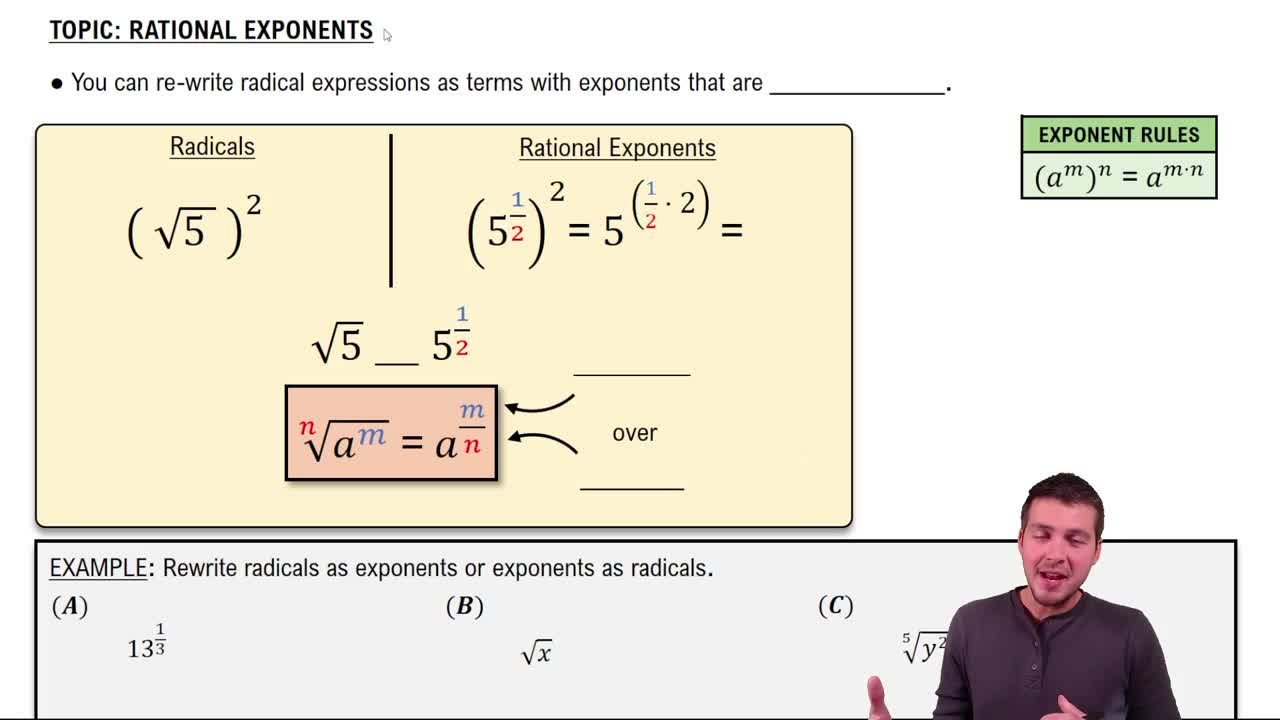
Rational Exponents

Simplifying Algebraic Fractions

Simplifying algebraic fractions involves reducing coefficients and variables separately. Coefficients are simplified by dividing their numerical values, while variables with exponents are simplified using exponent rules. This process helps to rewrite the expression in its simplest form.
Video consigliato:
05:07
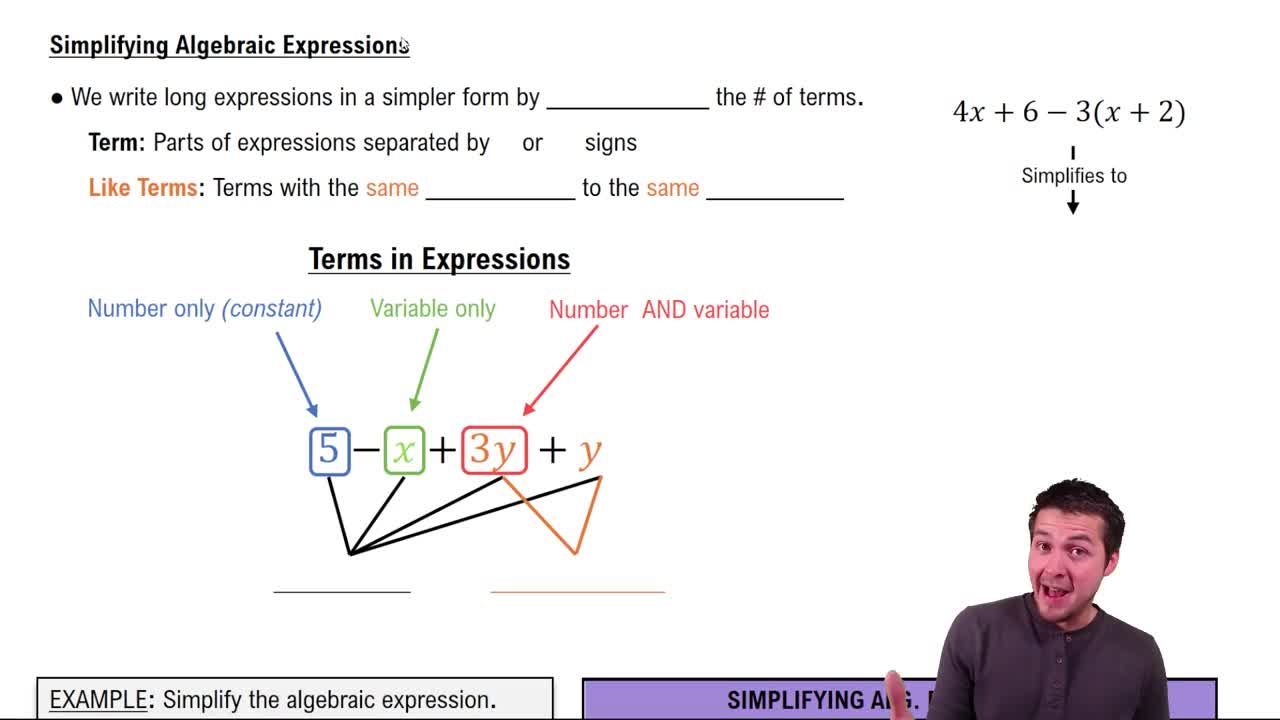
Simplifying Algebraic Expressions

Negative Exponents

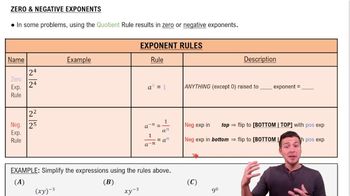
A negative exponent indicates the reciprocal of the base raised to the positive exponent. For example, x^(-n) equals 1/x^n. Understanding this concept is essential to simplify terms like y^(-3) in the denominator by moving them to the numerator with a positive exponent.
Video consigliato:
6:37
Zero and Negative Rules