20. Electrochemistry
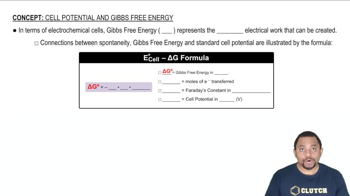
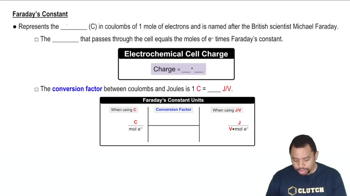
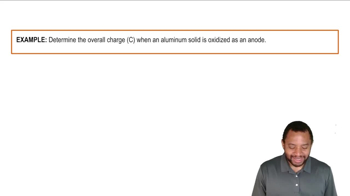
Cell Potential and Gibbs Free Energy
20. Electrochemistry
Cell Potential and Gibbs Free Energy
 01:28
01:28

Altri creatori di 3.
Impara con altri creatori





Mostrando 6 di 6 Video
Esercitati su questo argomento
- Scelta multipla
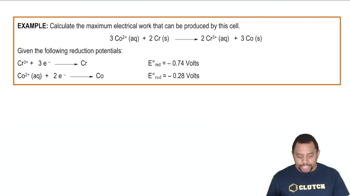
What is the Gibbs free energy change for the given reaction at 25ºC?
Au3+ (aq) + 3 Li (s) →. Au (s) + 3 Li+ (aq)
Given the following reduction potentials:
Au3+(aq) + 3 e– → Au (s) E°red = + 1.50 Volts
Li+ (aq) + e– → Li (s) E°red = – 3.04 Volts
1481views4rank - Scelta multipla
The reduction of chlorate is given by the equation:
ClO3– (aq) + 6 H3O+ (aq) → Cl – (aq) + 9 H2O (l)
If the standard cell potential is given as 1.373 V, how many electrons are transferred under standard conditions?
2077views3rank - Scelta multiplaIn an electrochemical cell, if the Gibbs free energy change (ΔG) is positive, what can be said about the cell potential (E°cell)?961views
- Scelta multiplaCalculate the maximum obtainable work in kJ for the balanced redox reaction below at 25 °C. Given: 3 MnO4–(aq) + 4 H+(aq) + 5 NO(g) --> 3 Mn2+(aq) + 2 H2O(l) + 5 NO3–(aq), E°cell = 0.540 V. (HINT: 1 V = 1 J/C)924views