21. Nuclear Chemistry
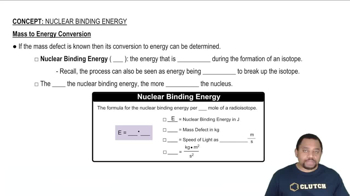
Nuclear Binding Energy
 02:06
02:06

Esercitati su questo argomento
- Scelta multipla
Calcium-41 is commonly used radioisotope in the study of osteoporosis. If calcium-41 has a mass of 40.962278 amu, determine the nuclear binding energy per nucleon in MeV. (1 amu = 1.66 × 10⁻²⁷ kg). (1 MeV = 1.60 × 10⁻¹³ J)
1119views2rank - Scelta multipla
Calculate the mass defect (in g/mol) for the formation of a helium-6 nucleus, and calculate the binding energy in (MeV)/nucleon. (1 amu = 1.66 × 10⁻²⁷ kg). (1 neutron = 1.00866 amu 1 proton = 1.00727 amu, & 1 electron = 0.00055 amu) (1 MeV = 1.60 × 10⁻¹³ J).
1292views1rank - Domanda aperta
The mass defect for a lithium-6 nucleus is -0.03434 g/mol. Calculate the atomic mass of lithium-6.
1687views - Domanda aperta
The most stable nucleus in terms of binding energy per nucleon is 56Fe. If the atomic mass of 56Fe is 55.9349 amu, calculate the binding energy per nucleon for 56Fe, in joules. The mass of a hydrogen atom is 1.0078 amu, and the mass of a neutron is 1.0087 amu. (1 J = 1 kg・m²/s², 1 amu = 1.66 × 10⁻²⁷ kg)
2374views - Scelta multiplaCalculate the total binding energy (in MeV) for the isotope 127I, given that the atomic mass is 126.90447 u and the atomic number is 53.845views
- Scelta multiplaDetermine the binding energy of an O-16 nucleus. The O-16 nucleus has a mass of 15.990526 amu. A proton has a mass of 1.007276 amu, and a neutron has a mass of 1.008665 amu. Use the conversion factor 1 amu = 931.5 MeV/c².836views