
Ch.1 - Introduction: Matter, Energy, and Measurement
Brown - Chemistry: The Central Science 14th Edition
Brown14th EditionChemistry: The Central ScienceISBN: 9780134414232Non è quello che usi tu?Cambia libro di testo
Capitolo 1, Problema 37b

(b) An experiment requires 45.0 g of ethylene glycol, a liquid whose density is 1.114 g/mL. Rather than weigh the sample on a balance, a chemist chooses to dispense the liquid using a graduated cylinder. What volume of the liquid should he use?

Guida verificata passo dopo passo
1
Identify the given information: mass of ethylene glycol is 45.0 g and its density is 1.114 g/mL.
Recall the formula for density: \( \text{Density} = \frac{\text{Mass}}{\text{Volume}} \).
Rearrange the formula to solve for volume: \( \text{Volume} = \frac{\text{Mass}}{\text{Density}} \).
Substitute the given values into the rearranged formula: \( \text{Volume} = \frac{45.0 \text{ g}}{1.114 \text{ g/mL}} \).
Calculate the volume to determine how much ethylene glycol to dispense using the graduated cylinder.

Risposta video verificata per un problema simile:

Questa soluzione video è stata consigliata dai nostri tutor come utile per risolvere questo problema.
Durata del video:
1m

Concetti chiave

Ecco i concetti essenziali che devi comprendere per rispondere correttamente alla domanda.

Density

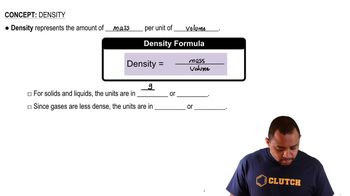
Density is defined as the mass of a substance per unit volume, typically expressed in grams per milliliter (g/mL) for liquids. It is a crucial property that helps in converting between mass and volume. In this case, the density of ethylene glycol is given as 1.114 g/mL, which means that each milliliter of this liquid weighs 1.114 grams.
Video consigliato:
Percorso guidato
01:56
Density Concepts

Volume Calculation

Volume can be calculated using the formula: Volume = Mass / Density. This relationship allows chemists to determine how much space a given mass of a substance will occupy based on its density. For the experiment, knowing the mass of ethylene glycol (45.0 g) and its density (1.114 g/mL) enables the calculation of the required volume.
Video consigliato:
Percorso guidato
02:35
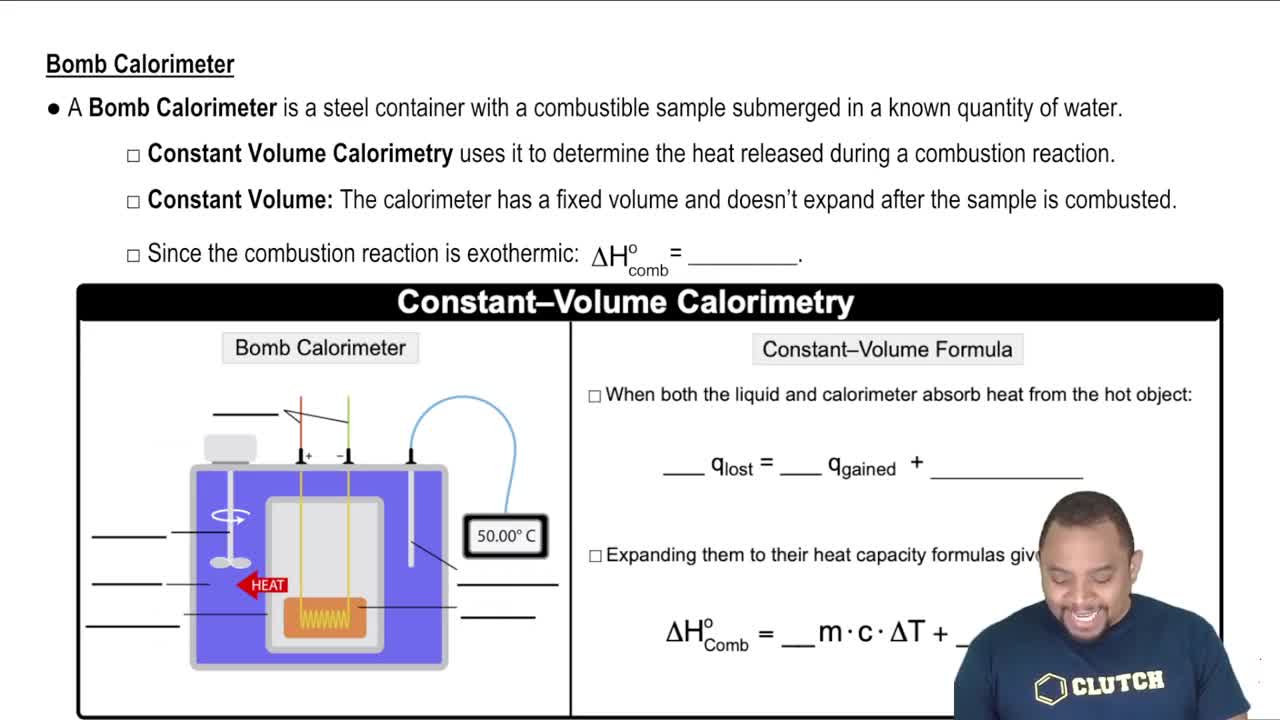
Constant-Volume Calorimetry

Graduated Cylinder Usage

A graduated cylinder is a common laboratory instrument used to measure the volume of liquids accurately. It is marked with measurement lines, allowing for precise readings. In this scenario, the chemist will use the calculated volume of ethylene glycol to dispense the correct amount from the graduated cylinder, ensuring the experiment's accuracy.
Video consigliato:
Percorso guidato
01:16
Metric Prefixes Usage
Pratica correlata
Domanda del libro di testo

(b) Carbon dioxide (CO2) is a gas at room temperature and pressure. However, carbon dioxide can be put under pressure to become a 'supercritical fluid' that is a much safer dry-cleaning agent than tetrachloroethylene. At a certain pressure, the density of supercritical CO2 is 0.469 g/cm3. What is the mass of a 25.0-mL sample of supercritical CO2 at this pressure?

1664
views
Domanda del libro di testo

(c) Is a graduated cylinder such as that shown in Figure 1.21 likely to afford the accuracy of measurement needed?

635
views
Domanda del libro di testo

(d) A cubic piece of metal measures 5.00 cm on each edge. If the metal is nickel, whose density is 8.90 g/cm3, what is the mass of the cube?

1450
views
1
rank
Domanda del libro di testo

(a) After the label fell off a bottle containing a clear liquid believed to be benzene, a chemist measured the density of the liquid to verify its identity. A 25.0-mL portion of the liquid had a mass of 21.95 g. A chemistry handbook lists the density of benzene at 15 °C as 0.8787 g/mL. Is the calculated density in agreement with the tabulated value?

850
views
Domanda del libro di testo

(a) To identify a liquid substance, a student determined its density. Using a graduated cylinder, she measured out a 45-mL sample of the substance. She then measured the mass of the sample, finding that it weighed 38.5 g. She knew that the substance had to be either isopropyl alcohol 1density 0.785 g/mL2 or toluene (density 0.866 g/mL). What are the calculated density and the probable identity of the substance?

1320
views