
Ch.12 - Solids and Modern Materials
Brown - Chemistry: The Central Science 14th Edition
Brown14th EditionChemistry: The Central ScienceISBN: 9780134414232Non è quello che usi tu?Cambia libro di testo
Capitolo 12, Problema 98

Indicate whether this statement is true or false: If you want a semiconductor that emits blue light, you could either use a material that has a band gap corresponding to the energy of a blue photon or you could use a material that has a smaller band gap but make an appropriately sized nanoparticle of the same material.

Guida verificata passo dopo passo
1
Step 1: Understand the concept of a semiconductor band gap. The band gap is the energy difference between the valence band and the conduction band in a semiconductor. For a semiconductor to emit light, an electron must transition from the conduction band to the valence band, releasing energy in the form of a photon.
Step 2: Determine the energy of a blue photon. Blue light has a wavelength of approximately 450-495 nm. Use the equation E = \(\frac{hc}{\lambda}\) to calculate the energy, where h is Planck's constant, c is the speed of light, and \(\lambda\) is the wavelength.
Step 3: Consider the first part of the statement. A semiconductor with a band gap equal to the energy of a blue photon will emit blue light when electrons transition from the conduction band to the valence band.
Step 4: Explore the concept of quantum confinement in nanoparticles. When the size of a semiconductor particle is reduced to the nanoscale, the band gap can increase due to quantum confinement effects, potentially allowing a material with a smaller bulk band gap to emit higher energy (shorter wavelength) light.
Step 5: Evaluate the statement. Both approaches mentioned in the statement are theoretically valid for achieving blue light emission: using a material with a band gap corresponding to blue light energy or using quantum confinement in nanoparticles to adjust the band gap.

Concetti chiave

Ecco i concetti essenziali che devi comprendere per rispondere correttamente alla domanda.

Band Gap Energy

The band gap energy is the energy difference between the valence band and the conduction band in a semiconductor. It determines the wavelengths of light that a material can absorb or emit. For a semiconductor to emit blue light, its band gap must correspond to the energy of blue photons, which is approximately 2.5 eV.
Video consigliato:
Percorso guidato
03:13
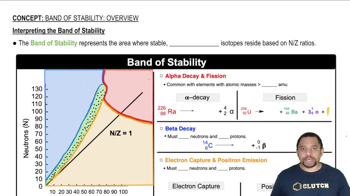
Intepreting the Band of Stability

Quantum Size Effect

The quantum size effect occurs when the dimensions of a semiconductor are reduced to the nanoscale, leading to quantization of energy levels. This effect can alter the band gap of the material, allowing a semiconductor with a smaller band gap to emit light at higher energies, such as blue light, when formed into nanoparticles.
Video consigliato:
Percorso guidato
02:31
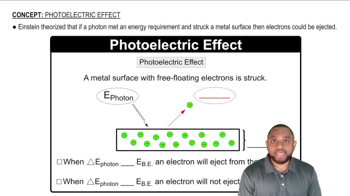
Photoelectric Effect

Photon Energy and Wavelength

The energy of a photon is inversely related to its wavelength, described by the equation E = hc/λ, where E is energy, h is Planck's constant, c is the speed of light, and λ is the wavelength. Blue light has a short wavelength (around 450 nm), which corresponds to higher energy photons, necessitating a suitable band gap in the semiconductor for effective emission.
Video consigliato:
Percorso guidato
01:40
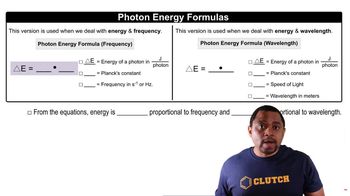
Photon Energy Formulas