Ch.12 - Solids and Modern Materials
Brown - Chemistry: The Central Science 14th Edition
Brown14th EditionChemistry: The Central ScienceISBN: 9780134414232Non è quello che usi tu?Cambia libro di testo
Capitolo 12, Problema 13d

What kinds of attractive forces exist between particles (atoms, molecules, or ions) in (d) and metallic crystals?

Guida verificata passo dopo passo
1
Identify the type of particles present in metallic crystals, which are metal atoms.
Understand that in metallic crystals, the atoms are arranged in a lattice structure.
Recognize that the primary attractive force in metallic crystals is the metallic bond.
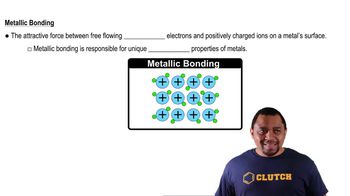
Explain that metallic bonds involve the attraction between positively charged metal ions and the 'sea of electrons' that are free to move throughout the structure.
Note that this 'sea of electrons' allows metals to conduct electricity and heat, and provides the malleability and ductility characteristic of metals.

Risposta video verificata per un problema simile:

Questa soluzione video è stata consigliata dai nostri tutor come utile per risolvere questo problema.
Durata del video:
30s

Concetti chiave

Ecco i concetti essenziali che devi comprendere per rispondere correttamente alla domanda.

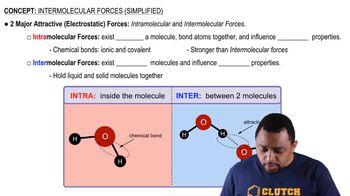
Intermolecular Forces

Intermolecular forces are the attractive forces that occur between molecules. These forces include hydrogen bonding, dipole-dipole interactions, and London dispersion forces. They play a crucial role in determining the physical properties of substances, such as boiling and melting points, and are essential for understanding the behavior of molecular compounds.
Video consigliato:
Percorso guidato
01:59
Intermolecular vs Intramolecular Forces

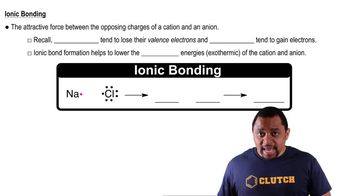
Ionic Bonds

Ionic bonds are formed through the electrostatic attraction between positively charged ions (cations) and negatively charged ions (anions). This type of bond typically occurs in ionic compounds, where electrons are transferred from one atom to another, resulting in the formation of charged particles. The strength of ionic bonds contributes to the high melting and boiling points of ionic compounds.
Video consigliato:

Metallic Bonding

Metallic bonding is characterized by a 'sea of electrons' that are free to move around, which allows metal atoms to share their valence electrons. This type of bonding results in properties such as electrical conductivity, malleability, and ductility. The attractive forces between the positively charged metal ions and the delocalized electrons are what hold the metallic structure together.
Video consigliato: