Ch.12 - Solids and Modern Materials
Brown - Chemistry: The Central Science 14th Edition
Brown14th EditionChemistry: The Central ScienceISBN: 9780134414232Non è quello che usi tu?Cambia libro di testo
Capitolo 12, Problema 13a

What kinds of attractive forces exist between particles (atoms, molecules, or ions) in (a) molecular crystals?

Guida verificata passo dopo passo
1
Identify the type of particles present in molecular crystals: In molecular crystals, the particles are molecules.
Understand the nature of molecular interactions: Molecular crystals are held together primarily by intermolecular forces rather than chemical bonds.
Recognize the types of intermolecular forces: The main types of intermolecular forces include London dispersion forces, dipole-dipole interactions, and hydrogen bonds.
Analyze the strength and characteristics of these forces: London dispersion forces are generally weaker and occur due to temporary dipoles. Dipole-dipole interactions occur between molecules with permanent dipoles. Hydrogen bonds are a stronger type of dipole-dipole interaction that occurs specifically when hydrogen is bonded to a highly electronegative atom like oxygen, nitrogen, or fluorine.
Apply this understanding to molecular crystals: In molecular crystals, the type of intermolecular force present depends on the specific molecules that make up the crystal. For example, ice (a molecular crystal of water) exhibits hydrogen bonding due to the polar nature of water molecules.

Risposta video verificata per un problema simile:

Questa soluzione video è stata consigliata dai nostri tutor come utile per risolvere questo problema.
Durata del video:
1m

Concetti chiave

Ecco i concetti essenziali che devi comprendere per rispondere correttamente alla domanda.

Intermolecular Forces

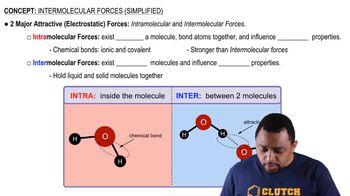
Intermolecular forces are the attractive forces that occur between molecules. These forces include hydrogen bonding, dipole-dipole interactions, and London dispersion forces. They play a crucial role in determining the physical properties of substances, such as boiling and melting points, especially in molecular crystals where these forces dictate how molecules are arranged and interact.
Video consigliato:
Percorso guidato
01:59
Intermolecular vs Intramolecular Forces

Molecular Crystals

Molecular crystals are solid structures formed by molecules held together primarily by intermolecular forces rather than ionic or covalent bonds. These crystals typically have lower melting points compared to ionic or metallic crystals due to the weaker nature of the intermolecular forces. Understanding the arrangement and types of molecules in these crystals is essential for predicting their properties and behaviors.
Video consigliato:
Percorso guidato
03:04
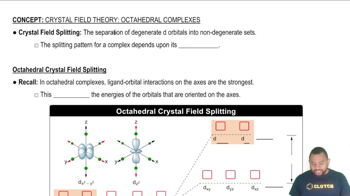
The crystal field splitting pattern for octahedral complexes has the d orbitals on or along the axes as having the higher energy.

Types of Attractive Forces

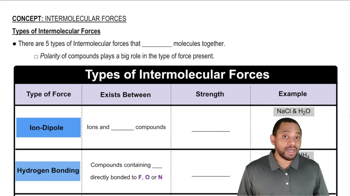
The types of attractive forces in molecular crystals include hydrogen bonds, which are strong interactions between molecules containing hydrogen bonded to electronegative atoms; dipole-dipole interactions, which occur between polar molecules; and London dispersion forces, which are weak attractions due to temporary dipoles in nonpolar molecules. Each type of force contributes differently to the stability and characteristics of the crystal structure.
Video consigliato:
Percorso guidato
06:44
Types of Intermolecular Forces