Ch.12 - Solids and Modern Materials
Brown - Chemistry: The Central Science 14th Edition
Brown14th EditionChemistry: The Central ScienceISBN: 9780134414232Non è quello che usi tu?Cambia libro di testo
Capitolo 12, Problema 12a

Silicon is the fundamental component of integrated circuits. Si has the same structure as diamond. (a) Is Si a molecular, metallic, ionic, or covalent-network solid?

Guida verificata passo dopo passo
1
Identify the types of solids: molecular, metallic, ionic, and covalent-network.
Consider the structure of silicon (Si) and compare it to diamond, which is a well-known covalent-network solid.
Recall that in a covalent-network solid, atoms are bonded in a continuous network entirely by covalent bonds.
Recognize that silicon, like diamond, forms a three-dimensional network of covalent bonds.
Conclude that silicon (Si) is a covalent-network solid due to its structure and bonding characteristics.

Risposta video verificata per un problema simile:

Questa soluzione video è stata consigliata dai nostri tutor come utile per risolvere questo problema.
Durata del video:
1m

Concetti chiave

Ecco i concetti essenziali che devi comprendere per rispondere correttamente alla domanda.

Types of Solids

Solids can be classified into four main types: molecular, metallic, ionic, and covalent-network solids. Molecular solids consist of molecules held together by intermolecular forces, metallic solids are composed of metal atoms sharing electrons, ionic solids are formed from the electrostatic attraction between ions, and covalent-network solids consist of a continuous network of covalent bonds, leading to high melting points and hardness.
Video consigliato:
Percorso guidato
01:31
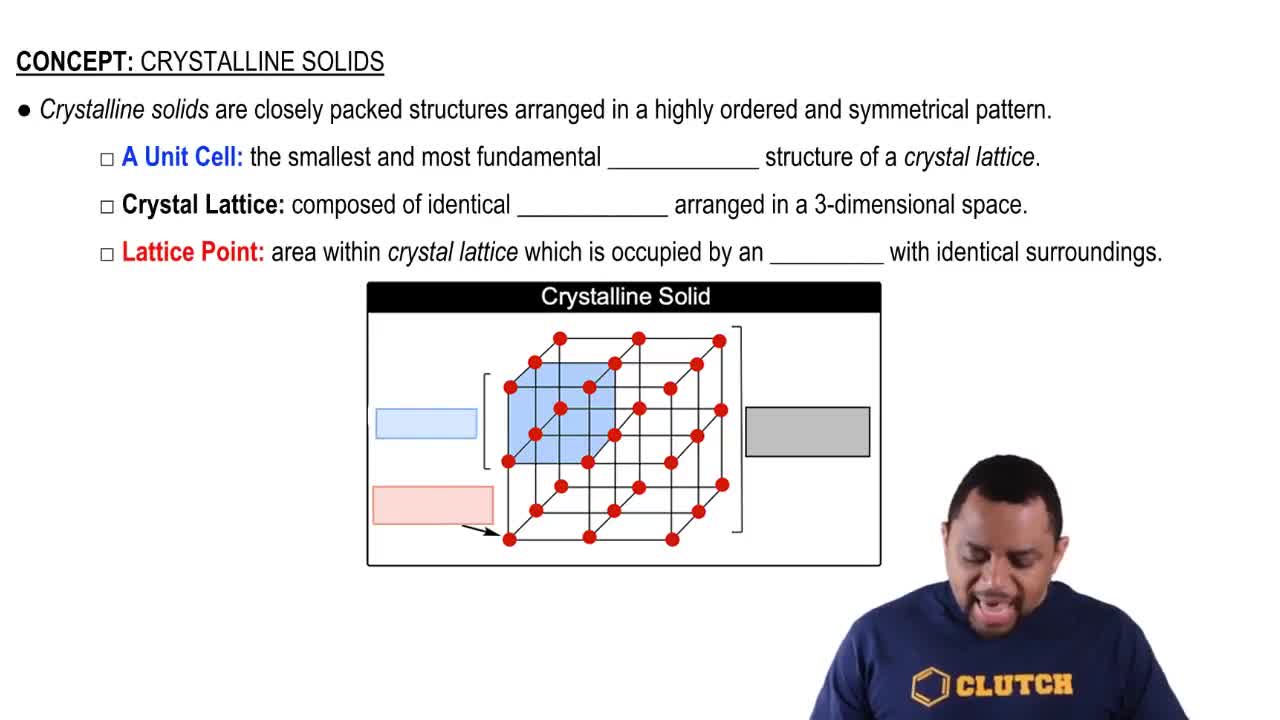
Crystalline Solids Structure

Covalent-Network Solids

Covalent-network solids are characterized by a three-dimensional network of covalent bonds, which results in strong interatomic interactions. This structure gives these materials high melting points and significant hardness. Diamond is a classic example, and silicon (Si) shares a similar tetrahedral bonding arrangement, making it a covalent-network solid.
Video consigliato:
Percorso guidato
04:13
Crystalline vs Amorphous Solids

Silicon in Electronics

Silicon is a crucial element in the electronics industry, primarily due to its semiconducting properties. Its ability to form a covalent-network solid allows for the manipulation of its electrical conductivity through doping, which is essential for creating integrated circuits. Understanding silicon's structure helps explain its role in technology and materials science.
Video consigliato:
Percorso guidato
01:14
Main Group Elements Valence Electrons Example