(b) What is the coordination number of each cannonball in the interior of the stack?
Ch.12 - Solids and Modern Materials
Brown14th EditionChemistry: The Central ScienceISBN: 9780134414232Non è quello che usi tu?Cambia libro di testo
Capitolo 12, Problema 7
Which of these molecular fragments would you expect to be more likely to give rise to electrical conductivity? Explain your reasoning. (a)

(b)
![]()
Guida verificata passo dopo passo1
Identify the key difference between the two molecular fragments: Fragment I has single bonds only, while Fragment II has alternating single and double bonds (conjugated system).
Recall that electrical conductivity in molecular structures is often associated with the presence of delocalized electrons.
Understand that delocalized electrons can move freely across the molecule, which is facilitated by the conjugated system in Fragment II.
Recognize that the conjugated system in Fragment II allows for the overlap of p-orbitals, creating a 'pi cloud' where electrons can move more freely.
Conclude that Fragment II is more likely to give rise to electrical conductivity due to the presence of delocalized electrons in the conjugated system.

Risposta video verificata per un problema simile:
Questa soluzione video è stata consigliata dai nostri tutor come utile per risolvere questo problema.
Durata del video:
1mConcetti chiave
Ecco i concetti essenziali che devi comprendere per rispondere correttamente alla domanda.
Electrical Conductivity
Electrical conductivity refers to the ability of a material to conduct electric current. This property is influenced by the presence of free-moving charged particles, such as electrons or ions. In molecular structures, the arrangement and type of atoms can determine how easily these charged particles can move, thus affecting conductivity.
Video consigliato:
Percorso guidato
Extensive Property Example
Molecular Structure and Bonding
The molecular structure and bonding of a compound significantly influence its physical properties, including conductivity. Structures with delocalized electrons, such as those found in conjugated systems or metals, typically exhibit higher conductivity. The arrangement of atoms in the provided diagrams may indicate the potential for electron mobility, which is crucial for conductivity.
Video consigliato:
Percorso guidato
Lewis Dot Structures: Sigma & Pi Bonds
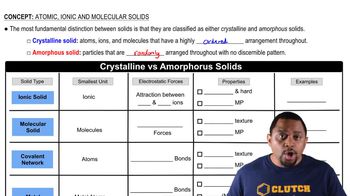
Crystalline vs. Amorphous Structures
Crystalline structures have a well-defined, ordered arrangement of atoms, which can facilitate the movement of electrons, enhancing conductivity. In contrast, amorphous structures lack this order, potentially hindering electron flow. The diagrams depict two different arrangements, and understanding their crystalline nature can help predict their electrical properties.
Video consigliato:
Percorso guidato
Crystalline vs Amorphous Solids
Pratica correlata
Domanda del libro di testo
386
views
Domanda del libro di testo
The accompanying image shows photoluminescence from four different samples of CdTe nanocrystals, each embedded in a polymer matrix. The photoluminescence occurs because the samples are being irradiated by a UV light source. The nanocrystals in each vial have different average sizes. The sizes are 4.0, 3.5, 3.2, and 2.8 nm. (a) Which vial contains the 4.0-nm nanocrystals?
268
views
Domanda del libro di testo
Shown here are cartoons of two different polymers. Which one would have the higher melting point?
273
views
Domanda del libro di testo
The electronic structure of a doped semiconductor is shown here. (c) Which region of the diagram represents the band gap?
382
views
Domanda del libro di testo
Which arrangement of cations (yellow) and anions (blue) in a lattice is the more stable? Explain your reasoning. (a)
(b)
392
views