Ch.12 - Solids and Modern Materials
Brown - Chemistry: The Central Science 14th Edition
Brown14th EditionChemistry: The Central ScienceISBN: 9780134414232Non è quello che usi tu?Cambia libro di testo
Capitolo 12, Problema 9b

Shown here are cartoons of two different polymers. Which one would have the higher melting point?
Cartoons of two polymers; left has linear chains, right has branched chains. Which has a higher melting point?

Guida verificata passo dopo passo
1
Identify the two types of polymer structures shown in the image: Polymer I has linear chains, and Polymer II has branched chains.
Recall that the melting point of a polymer is influenced by the strength of intermolecular forces and the degree of packing of the polymer chains.
Understand that linear polymers (Polymer I) can pack more closely together, leading to stronger intermolecular forces (e.g., van der Waals forces) and higher crystallinity.
Recognize that branched polymers (Polymer II) have irregular structures that prevent close packing, resulting in weaker intermolecular forces and lower crystallinity.
Conclude that Polymer I, with its linear chains, would have a higher melting point compared to Polymer II, which has branched chains.

Risposta video verificata per un problema simile:

Questa soluzione video è stata consigliata dai nostri tutor come utile per risolvere questo problema.
Durata del video:
2m

Concetti chiave

Ecco i concetti essenziali che devi comprendere per rispondere correttamente alla domanda.

Polymer Structure

Polymers are large molecules made up of repeating structural units called monomers. The arrangement of these monomers can significantly affect the properties of the polymer, including its melting point. Linear polymers, like those depicted in the left image, have a more organized structure, allowing for stronger intermolecular forces compared to branched polymers, which are more irregular and can lead to weaker interactions.
Video consigliato:
Percorso guidato
01:42
Resonance Structures

Intermolecular Forces

The melting point of a substance is largely determined by the strength of the intermolecular forces acting between its molecules. In polymers, stronger intermolecular forces, such as hydrogen bonding or van der Waals forces, result in higher melting points. Linear polymers typically exhibit stronger intermolecular forces due to their ability to pack closely together, while branched polymers have more space between chains, reducing these forces.
Video consigliato:
Percorso guidato
01:59
Intermolecular vs Intramolecular Forces

Crystallinity

Crystallinity refers to the degree to which a polymer's molecular chains are ordered. Higher crystallinity usually leads to higher melting points because the ordered structure allows for stronger intermolecular interactions. Linear polymers tend to be more crystalline than branched ones, which are often amorphous, resulting in lower melting points due to less efficient packing and weaker interactions.
Video consigliato:
Percorso guidato
01:31
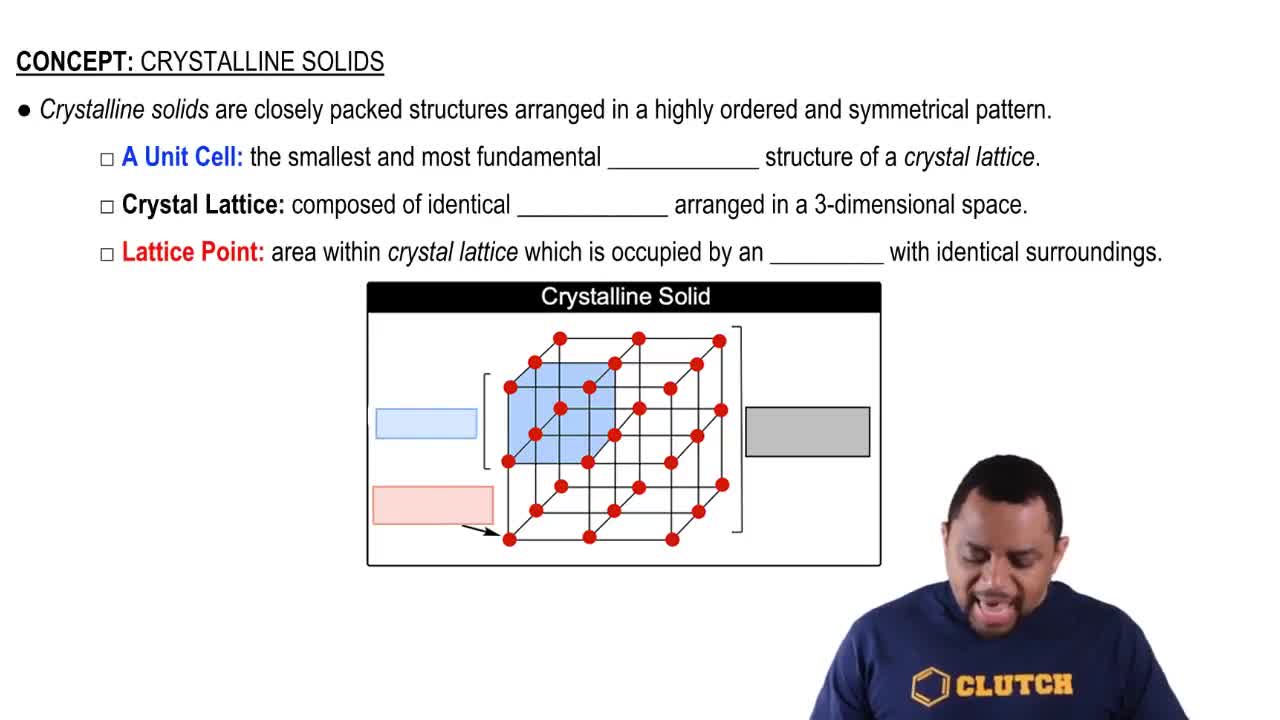
Crystalline Solids Structure