Indicate the principal type of solute–solvent interaction in each of the following solutions and rank the solutions from weakest to strongest solute–solvent interaction: (b) CH2Cl2 in benzene (C6H6)
Ch.13 - Properties of Solutions
Brown14th EditionChemistry: The Central ScienceISBN: 9780134414232Non è quello che usi tu?Cambia libro di testo
Capitolo 13, Problema 16a
Indicate the principal type of solute–solvent interaction in each of the following solutions and rank the solutions from weakest to strongest solute–solvent interaction: (a) KCl in water
Guida verificata passo dopo passo1
Identify the type of solute and solvent: KCl is an ionic compound, and water is a polar solvent.
Determine the principal type of interaction: In a solution of KCl in water, the principal interaction is ion-dipole interaction. This occurs because the positive and negative ions of KCl interact with the partial negative and positive charges of the water molecules, respectively.
Consider the strength of ion-dipole interactions: Ion-dipole interactions are generally strong because they involve the attraction between charged ions and polar molecules.
Compare with other types of interactions: Ion-dipole interactions are typically stronger than dipole-dipole interactions and hydrogen bonding, but weaker than covalent or ionic bonds.
Rank the interaction: Since the problem only provides one solution, KCl in water, it is ranked based on the strength of ion-dipole interactions, which are strong compared to other solute-solvent interactions.

Risposta video verificata per un problema simile:
Questa soluzione video è stata consigliata dai nostri tutor come utile per risolvere questo problema.
Durata del video:
1mConcetti chiave
Ecco i concetti essenziali che devi comprendere per rispondere correttamente alla domanda.
Ion-Dipole Interactions
Ion-dipole interactions occur between an ion and a polar molecule, such as water. In the case of KCl dissolved in water, the potassium (K+) and chloride (Cl-) ions interact with the dipole of water molecules, leading to strong solvation. This type of interaction is crucial for understanding how ionic compounds dissolve in polar solvents.
Video consigliato:
Percorso guidato
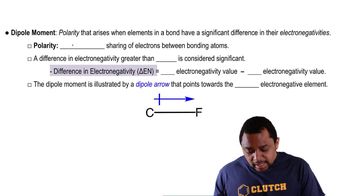
Dipole Moment
Solvation
Solvation is the process by which solvent molecules surround and interact with solute particles. In the context of KCl in water, solvation involves water molecules forming a hydration shell around the K+ and Cl- ions, stabilizing them in solution. This process is essential for the dissolution of ionic compounds and affects the overall solute-solvent interaction strength.
Video consigliato:
Percorso guidato
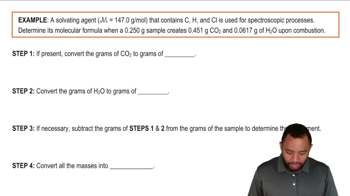
Molecular Formula via Combustion Example
Ranking Solute-Solvent Interactions
Ranking solute-solvent interactions involves comparing the strength of different types of interactions present in various solutions. In this case, KCl in water exhibits strong ion-dipole interactions, which are typically stronger than hydrogen bonding or van der Waals forces found in other solutions. Understanding this ranking helps predict the behavior of solutes in different solvents.
Video consigliato:
Percorso guidato
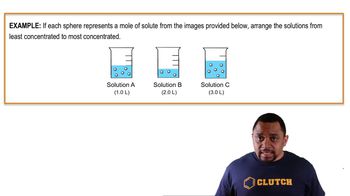
Ranking Solutions Example
Pratica correlata
Domanda del libro di testo
589
views
Domanda del libro di testo
Indicate the type of solute–solvent interaction (Section 11.2) that should be most important in each of the following solutions: (c) KBr in water
551
views
Domanda del libro di testo
Indicate the type of solute–solvent interaction (Section 11.2) that should be most important in each of the following solutions: (b) methanol (CH3OH) in water
966
views
Domanda del libro di testo
Indicate the principal type of solute–solvent interaction in each of the following solutions and rank the solutions from weakest to strongest solute–solvent interaction: (c) methanol (CH3OH) in water
549
views
Domanda del libro di testo
Indicate the type of solute–solvent interaction (Section 11.2) that should be most important in each of the following solutions: (d) HCl in acetonitrile (CH3CN)
759
views