Ch.13 - Properties of Solutions
Brown - Chemistry: The Central Science 14th Edition
Brown14th EditionChemistry: The Central ScienceISBN: 9780134414232Non è quello che usi tu?Cambia libro di testo
Capitolo 13, Problema 15c

Indicate the type of solute–solvent interaction (Section 11.2) that should be most important in each of the following solutions: (c) KBr in water

Guida verificata passo dopo passo
1
Step 1: Identify the solute and the solvent. In this case, KBr is the solute and water is the solvent.
Step 2: Determine the type of bonding in the solute. KBr is an ionic compound, which means it is made up of positive and negative ions.
Step 3: Determine the type of bonding in the solvent. Water is a polar molecule, which means it has a positive and a negative end.
Step 4: Based on the types of bonding in the solute and solvent, determine the type of solute-solvent interaction. In this case, the positive ions in KBr will be attracted to the negative ends of the water molecules, and the negative ions in KBr will be attracted to the positive ends of the water molecules.
Step 5: The type of solute-solvent interaction in this solution is ion-dipole interaction. This is because the ionic solute (KBr) interacts with the polar solvent (water) through attractions between the ions and the polar molecules.

Risposta video verificata per un problema simile:

Questa soluzione video è stata consigliata dai nostri tutor come utile per risolvere questo problema.
Durata del video:
1m

Concetti chiave

Ecco i concetti essenziali che devi comprendere per rispondere correttamente alla domanda.

Ionic Compounds and Solubility

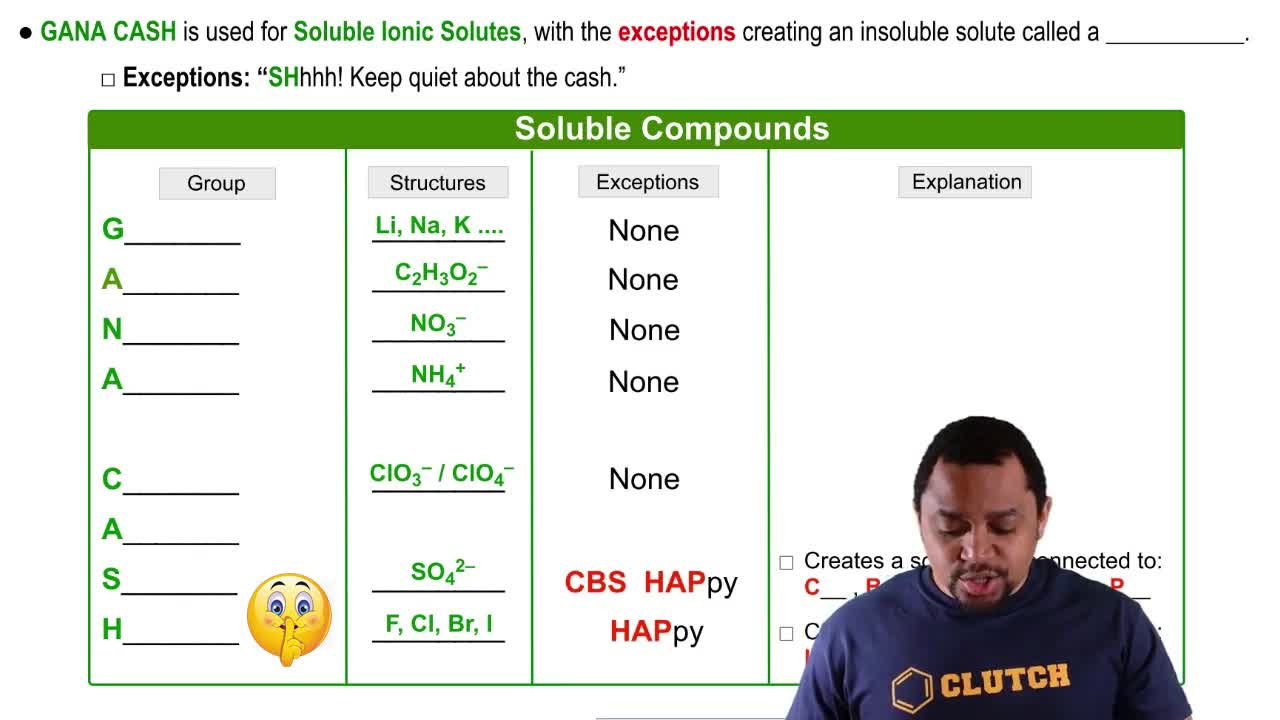
Ionic compounds, like KBr, consist of positively and negatively charged ions. When dissolved in water, these ions separate and interact with water molecules. The solubility of ionic compounds in water is largely determined by the strength of the interactions between the ions and the polar water molecules.
Video consigliato:
Percorso guidato
02:30
Soluble Ionic Solutes

Solute-Solvent Interactions

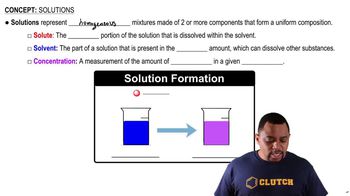
Solute-solvent interactions refer to the forces that occur between solute particles and solvent molecules. In the case of KBr in water, the primary interaction is ion-dipole forces, where the polar water molecules surround and stabilize the K+ and Br- ions, facilitating their dissolution.
Video consigliato:
Percorso guidato
01:39
Solution Components

Hydration Shell

A hydration shell is formed when water molecules surround and interact with dissolved ions. For KBr, the K+ ions attract the oxygen end of water molecules, while the Br- ions attract the hydrogen ends. This arrangement helps to keep the ions in solution and is crucial for understanding the solubility of ionic compounds in polar solvents like water.
Video consigliato:
Percorso guidato
02:04
Ionic Hydrates Naming