Ch.13 - Properties of Solutions
Brown - Chemistry: The Central Science 14th Edition
Brown14th EditionChemistry: The Central ScienceISBN: 9780134414232Non è quello che usi tu?Cambia libro di testo
Capitolo 13, Problema 15d

Indicate the type of solute–solvent interaction (Section 11.2) that should be most important in each of the following solutions: (d) HCl in acetonitrile (CH3CN)

Guida verificata passo dopo passo
1
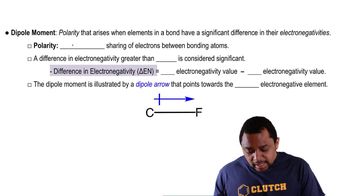
Identify the polarity of the solute (HCl) and the solvent (acetonitrile, CH3CN). HCl is a polar molecule due to the significant electronegativity difference between hydrogen and chlorine. Acetonitrile is also polar, with a triple bond between carbon and nitrogen creating a dipole moment.
Understand the types of solute-solvent interactions possible. These include ion-dipole, dipole-dipole, hydrogen bonding, and dispersion forces.
Determine the most likely interaction between HCl and acetonitrile. Since both are polar, dipole-dipole interactions are possible. Additionally, the positive end of the HCl dipole (hydrogen) can interact with the negative end of the acetonitrile dipole (nitrogen), suggesting possible ion-dipole interactions.
Consider the strength of these interactions. Ion-dipole interactions are generally stronger than dipole-dipole interactions because they involve a full charge interacting with a dipole.
Conclude that the most important type of solute-solvent interaction in a solution of HCl in acetonitrile is likely the ion-dipole interaction, where the hydrogen ion of HCl interacts with the negatively charged nitrogen in acetonitrile.

Risposta video verificata per un problema simile:

Questa soluzione video è stata consigliata dai nostri tutor come utile per risolvere questo problema.
Durata del video:
1m

Concetti chiave

Ecco i concetti essenziali che devi comprendere per rispondere correttamente alla domanda.

Solute-Solvent Interactions

Solute-solvent interactions refer to the various forces that occur between solute particles and solvent molecules when a solution is formed. These interactions can include hydrogen bonding, dipole-dipole interactions, and ion-dipole interactions, which significantly influence the solubility and behavior of solutes in solvents.
Video consigliato:
Percorso guidato
01:39
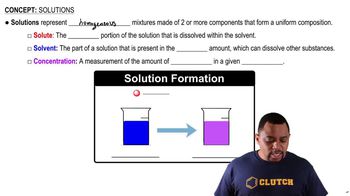
Solution Components

Acetonitrile as a Solvent

Acetonitrile (CH₃CN) is a polar aprotic solvent, meaning it has a significant dipole moment but lacks hydrogen atoms that can participate in hydrogen bonding. This property allows it to solvate cations effectively through dipole-dipole interactions, making it suitable for dissolving ionic and polar solutes like HCl.
Video consigliato:
Percorso guidato
02:40
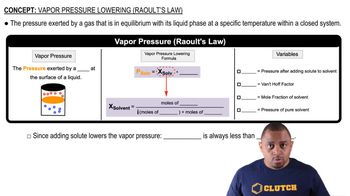
Raoult's Law and Vapor Pressure

Ion-Dipole Interactions

Ion-dipole interactions occur when an ion interacts with the polar ends of a solvent molecule. In the case of HCl in acetonitrile, the H⁺ ion from HCl will interact strongly with the dipole of the acetonitrile molecules, which stabilizes the ion in solution and is a key factor in determining the solubility of ionic compounds in polar solvents.
Video consigliato: