
The accompanying graph shows plots of ln k versus 1>T for two different reactions. The plots have been extrapolated to the y-intercepts. Which reaction (red or blue) has (b) the larger value for the frequency factor, A? [Section 14.5]
Ch.14 - Chemical Kinetics
Brown14th EditionChemistry: The Central ScienceISBN: 9780134414232Non è quello che usi tu?Cambia libro di testo
Capitolo 14, Problema 13
Based on the following reaction profile, how many intermediates are formed in the reaction A¡C? How many transition states are there? Which step, A¡B or B¡C, is the faster? For the reaction A¡C, is ΔE positive, negative, or zero? [Section 14.6]

Guida verificata passo dopo passo1
Identify the intermediates: Intermediates are species that are formed during the reaction but are not present in the final products. In the reaction profile, intermediates correspond to valleys between peaks. Count the number of valleys.
Identify the transition states: Transition states are the highest energy points along the reaction path, corresponding to the peaks in the reaction profile. Count the number of peaks.
Compare the activation energies: The step with the lower activation energy (the energy difference between the reactant and the peak) is the faster step. Compare the heights of the peaks for A→B and B→C.
Determine the overall energy change (ΔE): Compare the potential energy of the reactants (A) and the products (C). If the energy of C is lower than A, ΔE is negative. If higher, ΔE is positive. If they are the same, ΔE is zero.
Summarize the findings: State the number of intermediates, the number of transition states, which step is faster, and whether ΔE is positive, negative, or zero.

Risposta video verificata per un problema simile:
Questa soluzione video è stata consigliata dai nostri tutor come utile per risolvere questo problema.
Durata del video:
2mConcetti chiave
Ecco i concetti essenziali che devi comprendere per rispondere correttamente alla domanda.
Reaction Intermediates
Reaction intermediates are species that are formed during the conversion of reactants to products but are not present in the final products. In the energy diagram, intermediates correspond to the local minima in potential energy, such as points X and Z in the provided diagram. Identifying intermediates is crucial for understanding the mechanism of the reaction.
Video consigliato:
Percorso guidato
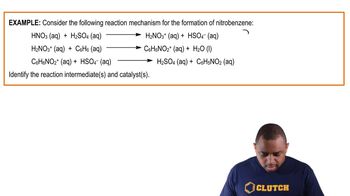
Reaction Mechanism Example
Transition States
Transition states are high-energy states that occur during the transformation of reactants to products. They represent the maximum energy point along the reaction pathway, depicted as the peaks in the energy diagram, such as point Y. Transition states are critical for determining the activation energy and the rate of the reaction.
Video consigliato:
Percorso guidato
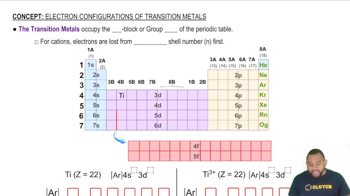
Transition Metals
Activation Energy and Reaction Rate
Activation energy is the minimum energy required for a reaction to occur, influencing the rate of the reaction. The step with the higher activation energy is typically slower. By comparing the energy differences between the reactants and the transition states for steps A→B and B→C, one can determine which step is faster and whether the overall reaction has a positive, negative, or zero change in energy (ΔE).
Video consigliato:
Percorso guidato
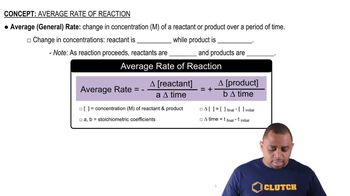
Average Rate of Reaction
Pratica correlata
Domanda del libro di testo
780
views
Domanda del libro di testo
The following graph shows two different reaction pathways for the same overall reaction at the same temperature. Is each of the following statements true or false? (b) For both paths, the rate of the reverse reaction is slower than the rate of the forward reaction.
1157
views
Domanda del libro di testo
(b) Name three factors that can affect the rate of a chemical reaction.
587
views
Domanda del libro di testo
Consider the diagram that follows, which represents two steps in an overall reaction. The red spheres are oxygen, the blue ones nitrogen, and the green ones fluorine. (d) Write the rate law for the overall reaction if the first step is the slow, rate-determining step. [Section 14.6]
462
views
