
Ch.14 - Chemical Kinetics
Brown - Chemistry: The Central Science 14th Edition
Brown14th EditionChemistry: The Central ScienceISBN: 9780134414232Non è quello che usi tu?Cambia libro di testo
Capitolo 14, Problema 39a

(a) For the generic reaction A → B what quantity, when graphed versus time, will yield a straight line for a first-order reaction?

Guida verificata passo dopo passo
1
Identify the order of the reaction given in the problem, which is a first-order reaction.
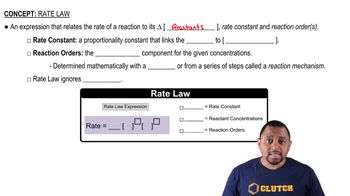
Recall that for a first-order reaction, the rate of reaction is directly proportional to the concentration of one reactant. The rate law can be expressed as: \(rate = k[A]\), where \(k\) is the rate constant and \([A]\) is the concentration of reactant A.
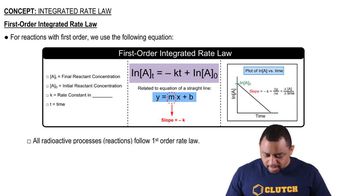
Understand that for a first-order reaction, the natural logarithm of the concentration of the reactant versus time will yield a straight line. This is derived from the integrated rate law for a first-order reaction: \(\ln[A] = -kt + \ln[A]_0\), where \([A]_0\) is the initial concentration of A.
Set up the graph with time (t) on the x-axis and the natural logarithm of the concentration of A (\(\ln[A]\)) on the y-axis.
Plot the data points for \(\ln[A]\) versus time and draw the best fit line. The slope of this line will be equal to \(-k\), and the y-intercept will be \(\ln[A]_0\).

Risposta video verificata per un problema simile:

Questa soluzione video è stata consigliata dai nostri tutor come utile per risolvere questo problema.
Durata del video:
1m

Concetti chiave

Ecco i concetti essenziali che devi comprendere per rispondere correttamente alla domanda.

First-Order Reactions

First-order reactions are chemical reactions where the rate is directly proportional to the concentration of one reactant. This means that as the concentration of the reactant decreases, the rate of reaction also decreases in a linear fashion. The mathematical representation of a first-order reaction is given by the equation: rate = k[A], where k is the rate constant and [A] is the concentration of reactant A.
Video consigliato:
Percorso guidato
02:29
First-Order Reactions

Integrated Rate Law

The integrated rate law for a first-order reaction relates the concentration of the reactant to time. It is expressed as ln[A] = -kt + ln[A]₀, where [A]₀ is the initial concentration, k is the rate constant, and t is time. When plotted, a graph of ln[A] versus time yields a straight line with a slope of -k, indicating that the reaction follows first-order kinetics.
Video consigliato:
Percorso guidato
01:52
Rate Law Fundamentals

Graphing Reaction Kinetics

Graphing is a crucial tool in analyzing reaction kinetics. For first-order reactions, plotting the natural logarithm of the concentration of the reactant (ln[A]) against time results in a straight line. This linear relationship allows chemists to determine the rate constant (k) and understand the reaction's behavior over time, providing insights into the reaction mechanism and dynamics.
Video consigliato:
Percorso guidato
03:06
Chemical Kinetics
Pratica correlata
Domanda del libro di testo

Consider the reaction of peroxydisulfate ion (S2O82-) with iodide ion (I-) in aqueous solution:

S2O82-(aq) + 3 I-(aq) → 2 SO42-(aq) + I3-(aq)

 At a particular temperature, the initial rate of disappearance of S2O82- varies with reactant concentrations in the following manner:

Experiment [S2O82-] (M) [I-] (M) Initial Rate (M/s)

1 0.018 0.036 2.6 × 10⁻⁶

2 0.027 0.036 3.9 × 10⁻⁶

3 0.036 0.054 7.8 × 10⁻⁶

4 0.050 0.072 1.4 × 10⁻⁵

(a) Determine the rate law for the reaction and state the units of the rate constant.

2175
views
Domanda del libro di testo

(a) The gas-phase decomposition of SO2Cl2, SO2Cl2(g) → SO2(g) + Cl2(g), is first order in SO2Cl2. At 600 K the half-life for this process is 2.3 × 10⁵ s. What is the rate constant at this temperature?

1430
views
Domanda del libro di testo

Consider the gas-phase reaction between nitric oxide and bromine at 273°C: 2 NO(g) + Br2(g) → 2 NOBr(g). The following data for the initial rate of appearance of NOBr were obtained:

Experiment [NO] (M) [Br2] (M) Initial Rate (M/s)

1 0.10 0.20 24

2 0.25 0.20 150

3 0.10 0.50 60

4 0.35 0.50 735 

(b) Calculate the average value of the rate constant for the appearance of NOBr from the four data sets.

1004
views
Domanda del libro di testo

(b) How can you calculate the rate constant for a first-order reaction from the graph you made in part (a)?

Domanda del libro di testo

The decomposition of sodium bicarbonate (baking soda), NaHCO3(s), into Na2CO3(s), H2O(l), and CO2(g) at constant pressure requires the addition of 85 kJ of heat per two moles of NaHCO3. (b) Draw an enthalpy diagram for the reaction.

1261
views