
Ch.14 - Chemical Kinetics
Brown - Chemistry: The Central Science 14th Edition
Brown14th EditionChemistry: The Central ScienceISBN: 9780134414232Non è quello che usi tu?Cambia libro di testo
Capitolo 14, Problema 41a

(a) The gas-phase decomposition of SO2Cl2, SO2Cl2(g) → SO2(g) + Cl2(g), is first order in SO2Cl2. At 600 K the half-life for this process is 2.3 × 10⁵ s. What is the rate constant at this temperature?

Guida verificata passo dopo passo
1
Step 1: Understand the problem. We are given that the reaction is first order and we are given the half-life. We need to find the rate constant (k).
Step 2: Recall the formula for the rate constant in a first order reaction. The formula is k = ln(2) / t1/2, where t1/2 is the half-life of the reaction.
Step 3: Substitute the given half-life into the formula. The half-life is given as 2.3 * 10^5 s.
Step 4: Calculate the rate constant. Remember that ln(2) is approximately 0.693.
Step 5: The rate constant k is then the result of the calculation from step 4. This is the final answer.

Risposta video verificata per un problema simile:

Questa soluzione video è stata consigliata dai nostri tutor come utile per risolvere questo problema.
Durata del video:
1m

Concetti chiave

Ecco i concetti essenziali che devi comprendere per rispondere correttamente alla domanda.

First-Order Reactions

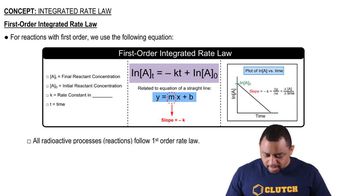
First-order reactions are chemical reactions where the rate is directly proportional to the concentration of one reactant. This means that as the concentration of the reactant decreases, the rate of the reaction also decreases. The rate law for a first-order reaction can be expressed as rate = k[A], where k is the rate constant and [A] is the concentration of the reactant.
Video consigliato:
Percorso guidato
02:29
First-Order Reactions

Half-Life of a Reaction

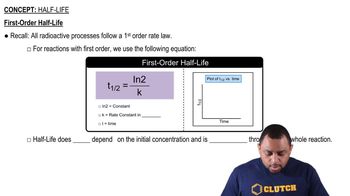
The half-life of a reaction is the time required for the concentration of a reactant to decrease to half of its initial value. For first-order reactions, the half-life is constant and independent of the initial concentration, calculated using the formula t1/2 = 0.693/k, where k is the rate constant. This relationship is crucial for determining the rate constant from the given half-life.
Video consigliato:
Percorso guidato
01:49
First-Order Half-Life

Rate Constant (k)

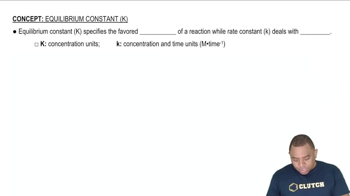
The rate constant (k) is a proportionality factor in the rate law that quantifies the speed of a reaction at a given temperature. It is specific to each reaction and varies with temperature. For first-order reactions, the rate constant can be derived from the half-life using the equation k = 0.693/t1/2, allowing us to calculate k when the half-life is known.
Video consigliato:
Percorso guidato
01:14
Equilibrium Constant K