
Ch.14 - Chemical Kinetics
Brown - Chemistry: The Central Science 14th Edition
Brown14th EditionChemistry: The Central ScienceISBN: 9780134414232Non è quello che usi tu?Cambia libro di testo
Capitolo 14, Problema 39b

(b) How can you calculate the rate constant for a first-order reaction from the graph you made in part (a)?

Guida verificata passo dopo passo
1
Identify the type of graph you have created in part (a). For a first-order reaction, you should have plotted the natural logarithm of the concentration of the reactant, \( \ln[A] \), versus time.
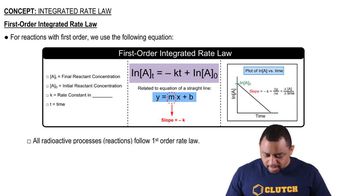
Understand that the slope of the line in this graph represents the negative of the rate constant, \( k \), for the reaction. This is derived from the integrated rate law for a first-order reaction: \( \ln[A] = -kt + \ln[A_0] \), where \( [A_0] \) is the initial concentration.
Determine the slope of the line from your graph. This can be done by selecting two points on the line and using the formula for the slope: \( \text{slope} = \frac{\Delta y}{\Delta x} \), where \( \Delta y \) is the change in \( \ln[A] \) and \( \Delta x \) is the change in time.
Recognize that the slope you calculated is equal to \( -k \). Therefore, the rate constant \( k \) is the negative of the slope value you obtained.
Ensure that the units of the rate constant \( k \) are consistent with the units of time used in your graph. For a first-order reaction, \( k \) typically has units of \( \text{time}^{-1} \), such as \( \text{s}^{-1} \) or \( \text{min}^{-1} \).

Risposta video verificata per un problema simile:

Questa soluzione video è stata consigliata dai nostri tutor come utile per risolvere questo problema.
Durata del video:
4m

Concetti chiave

Ecco i concetti essenziali che devi comprendere per rispondere correttamente alla domanda.

First-Order Reactions

First-order reactions are chemical reactions where the rate is directly proportional to the concentration of one reactant. This means that if the concentration of the reactant doubles, the reaction rate also doubles. The rate law for a first-order reaction can be expressed as rate = k[A], where k is the rate constant and [A] is the concentration of the reactant.
Video consigliato:
Percorso guidato
02:29
First-Order Reactions

Rate Constant (k)

The rate constant (k) is a proportionality factor in the rate law that is specific to a given reaction at a specific temperature. For first-order reactions, the rate constant can be determined from the slope of a plot of the natural logarithm of the concentration of the reactant versus time. The units of k for a first-order reaction are typically s⁻¹.
Video consigliato:
Percorso guidato
01:14
Equilibrium Constant K

Graphical Analysis of Reaction Kinetics

Graphical analysis involves plotting data to visualize relationships between variables. For first-order reactions, plotting ln[A] versus time yields a straight line, where the slope of the line is equal to -k. This method allows for the determination of the rate constant from experimental data, making it a powerful tool in kinetics studies.
Video consigliato:
Percorso guidato
06:11
Dimensional Analysis