
Ch.14 - Chemical Kinetics
Brown - Chemistry: The Central Science 14th Edition
Brown14th EditionChemistry: The Central ScienceISBN: 9780134414232Non è quello che usi tu?Cambia libro di testo
Capitolo 14, Problema 41b

(b) At 320°C the rate constant is 2.2 × 10⁻⁵ s-1. What is the half-life at this temperature?

Guida verificata passo dopo passo
1
Identify the type of reaction. Since the rate constant is given in s-1, this suggests a first-order reaction.
Recall the formula for the half-life of a first-order reaction: t1/2=0.693k, where k is the rate constant.
Substitute the given rate constant value into the formula: t1/2=0.6932.2×10-5.
Perform the division to calculate the half-life: divide 0.693 by the rate constant value.
The result from the division will give you the half-life of the reaction at 320°C.

Risposta video verificata per un problema simile:

Questa soluzione video è stata consigliata dai nostri tutor come utile per risolvere questo problema.
Durata del video:
1m

Concetti chiave

Ecco i concetti essenziali che devi comprendere per rispondere correttamente alla domanda.

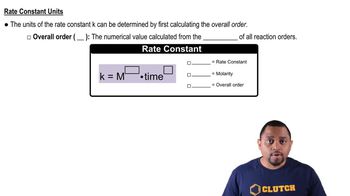
Rate Constant

The rate constant (k) is a proportionality factor in the rate equation of a chemical reaction, indicating the speed of the reaction at a given temperature. It is specific to the reaction and varies with temperature, reflecting how the frequency of effective collisions between reactants changes. In this case, the rate constant is given as 2.2 × 10<sup>-5</sup> s<sup>-1</sup>, which is essential for calculating the half-life.
Video consigliato:
Percorso guidato
00:45
Rate Constant Units

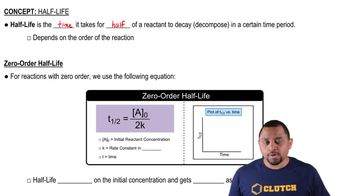
Half-Life

Half-life is the time required for the concentration of a reactant to decrease to half of its initial value. For first-order reactions, the half-life is inversely proportional to the rate constant, allowing for straightforward calculations. The formula for half-life (t<sub>1/2</sub>) in first-order kinetics is t<sub>1/2</sub> = 0.693/k, where k is the rate constant.
Video consigliato:
Percorso guidato
02:17
Zero-Order Half-life

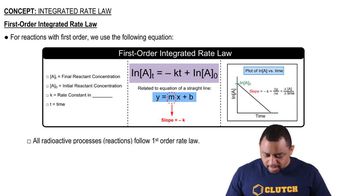
First-Order Kinetics

First-order kinetics describes a reaction where the rate is directly proportional to the concentration of one reactant. This means that as the concentration decreases, the rate of reaction also decreases. The relationship between the rate constant and half-life in first-order reactions simplifies calculations, making it easier to determine how long it takes for a substance to reduce to half its amount.
Video consigliato:
Percorso guidato
02:29
First-Order Reactions