
Ch.15 - Chemical Equilibrium
Brown - Chemistry: The Central Science 14th Edition
Brown14th EditionChemistry: The Central ScienceISBN: 9780134414232Non è quello che usi tu?Cambia libro di testo
Capitolo 15, Problema 69a

(a) Is the dissociation of fluorine molecules into atomic fluorine, F2(𝑔) ⇌ 2 F(𝑔), an exothermic or endothermic process?

Guida verificata passo dopo passo
1
Identify the type of reaction: The dissociation of fluorine molecules into atomic fluorine is a bond-breaking process.
Recall the general rule that breaking chemical bonds requires energy, while forming chemical bonds releases energy.
Determine the nature of the energy change: Since the reaction involves breaking the F-F bond in F2(g) to form atomic fluorine, energy is absorbed from the surroundings.
Conclude the type of thermodynamic process: If a reaction absorbs energy, it is considered endothermic.
State the answer: The dissociation of fluorine molecules into atomic fluorine is an endothermic process.

Risposta video verificata per un problema simile:

Questa soluzione video è stata consigliata dai nostri tutor come utile per risolvere questo problema.
Durata del video:
3m

Concetti chiave

Ecco i concetti essenziali che devi comprendere per rispondere correttamente alla domanda.

Dissociation Reactions

Dissociation reactions involve the breaking of bonds in a compound to form individual atoms or smaller molecules. In the case of fluorine, the reaction F₂(g) ⇌ 2 F(g) represents the dissociation of diatomic fluorine into two monatomic fluorine atoms. Understanding this process is crucial for determining the energy changes associated with the reaction.
Video consigliato:
Percorso guidato
04:52
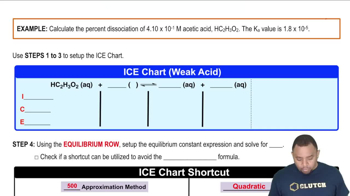
Percent Dissociation Example

Exothermic vs. Endothermic Processes

Exothermic processes release energy, usually in the form of heat, while endothermic processes absorb energy from the surroundings. The classification of a reaction as exothermic or endothermic can be determined by the energy changes that occur during bond breaking and formation. This distinction is essential for analyzing the thermodynamics of the dissociation of fluorine.
Video consigliato:
Percorso guidato
1:48
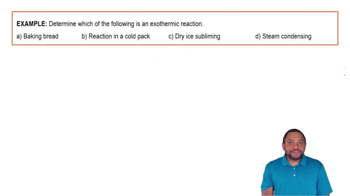
Endothermic & Exothermic Reactions Example 2

Bond Energy

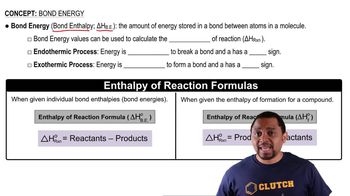
Bond energy is the amount of energy required to break a bond between two atoms. In the context of the dissociation of F₂, the bond energy of the F-F bond must be considered to evaluate whether the process is exothermic or endothermic. If the energy required to break the bond is greater than the energy released when forming new bonds, the process is endothermic, and vice versa.
Video consigliato: