Methanol (CH3OH) can be made by the reaction of CO with H2: CO(𝑔) + 2 H2(𝑔) ⇌ CH3OH(𝑔) (b) To maximize the equilibrium yield of methanol, would you use a high or low temperature?
Ch.15 - Chemical Equilibrium
Brown14th EditionChemistry: The Central ScienceISBN: 9780134414232Non è quello che usi tu?Cambia libro di testo
Capitolo 15, Problema 67
Ozone, O3, decomposes to molecular oxygen in the stratosphere according to the reaction 2 O31g2¡3 O21g2. Would an increase in pressure favor the formation of ozone or of oxygen?
Guida verificata passo dopo passo1
Identify the reaction: 2 O_3(g) \(\rightarrow\) 3 O_2(g).
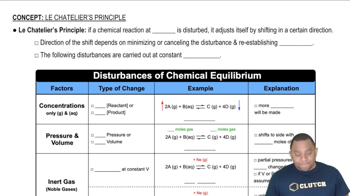
Apply Le Chatelier's Principle, which states that a system at equilibrium will adjust to counteract any changes imposed on it.
Consider the effect of pressure on the reaction. Increasing pressure favors the side with fewer moles of gas.
Count the moles of gas on each side of the reaction: 2 moles of O_3 on the left and 3 moles of O_2 on the right.
Determine which side is favored by increased pressure: the side with fewer moles, which is the reactants (O_3).

Risposta video verificata per un problema simile:
Questa soluzione video è stata consigliata dai nostri tutor come utile per risolvere questo problema.
Durata del video:
3mConcetti chiave
Ecco i concetti essenziali che devi comprendere per rispondere correttamente alla domanda.
Le Chatelier's Principle
Le Chatelier's Principle states that if a dynamic equilibrium is disturbed by changing the conditions, the position of equilibrium shifts to counteract the change. In the context of gas reactions, increasing pressure will favor the side of the reaction with fewer moles of gas, as this reduces the overall pressure.
Video consigliato:
Percorso guidato
Le Chatelier's Principle
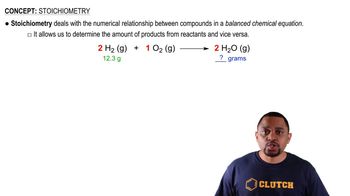
Stoichiometry of the Reaction
The stoichiometry of the reaction 2 O3(g) → 3 O2(g) indicates that two moles of ozone decompose to produce three moles of oxygen. This means that for every two moles of ozone, three moles of oxygen are generated, resulting in an increase in the total number of gas moles when ozone decomposes.
Video consigliato:
Percorso guidato
Stoichiometry Concept
Gas Laws
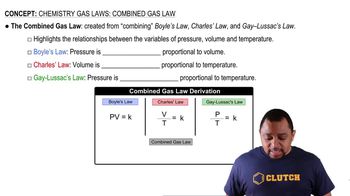
Gas laws describe the behavior of gases under various conditions of pressure, volume, and temperature. According to the ideal gas law, increasing pressure at constant temperature will affect the equilibrium position of a reaction involving gases, influencing the amounts of reactants and products present.
Video consigliato:
Percorso guidato
Combined Gas Law
Pratica correlata
Domanda del libro di testo
583
views
Domanda del libro di testo
(a) Is the dissociation of fluorine molecules into atomic fluorine, F2(𝑔) ⇌ 2 F(𝑔), an exothermic or endothermic process?
711
views
Domanda del libro di testo
Methanol (CH3OH) can be made by the reaction of CO with H2: CO(𝑔) + 2 H2(𝑔) ⇌ CH3OH(𝑔) (a) Use thermochemical data in Appendix C to calculate ΔH° for this reaction.
1098
views
Domanda del libro di testo
The water–gas shift reaction CO1g2 + H2O1g2Δ
CO21g2 + H21g2 is used industrially to produce hydrogen.
The reaction enthalpy is H = -41 kJ.
(b) Could you increase the equilibrium yield
of hydrogen by controlling the pressure of this reaction? If
so would high or low pressure favor formation of H2(g)?
1407
views
1
rank
Domanda del libro di testo
(b) If the temperature is raised by 100 K, does the equilibrium constant for this reaction increase or decrease?
626
views
Domanda del libro di testo
Methanol (CH3OH) can be made by the reaction of CO with H2: CO(𝑔) + 2 H2(𝑔) ⇌ CH3OH(𝑔) (c) To maximize the equilibrium yield of methanol, would you use a high or low pressure?
435
views