Ch.15 - Chemical Equilibrium
Brown - Chemistry: The Central Science 14th Edition
Brown14th EditionChemistry: The Central ScienceISBN: 9780134414232Non è quello che usi tu?Cambia libro di testo
Capitolo 15, Problema 69b

(b) If the temperature is raised by 100 K, does the equilibrium constant for this reaction increase or decrease?

Guida verificata passo dopo passo
1
insert step 1> Identify the type of reaction (endothermic or exothermic) using the enthalpy change (\( \Delta H \)) of the reaction.
insert step 2> Recall Le Chatelier's Principle, which states that a system at equilibrium will adjust to counteract any changes imposed on it.
insert step 3> Understand that for an endothermic reaction (\( \Delta H > 0 \)), increasing temperature shifts the equilibrium to the right, favoring the formation of products, thus increasing the equilibrium constant (\( K \)).
insert step 4> Conversely, for an exothermic reaction (\( \Delta H < 0 \)), increasing temperature shifts the equilibrium to the left, favoring the formation of reactants, thus decreasing the equilibrium constant (\( K \)).
insert step 5> Conclude whether the equilibrium constant increases or decreases based on the reaction's enthalpy change and the temperature increase.

Risposta video verificata per un problema simile:

Questa soluzione video è stata consigliata dai nostri tutor come utile per risolvere questo problema.
Durata del video:
3m

Concetti chiave

Ecco i concetti essenziali che devi comprendere per rispondere correttamente alla domanda.

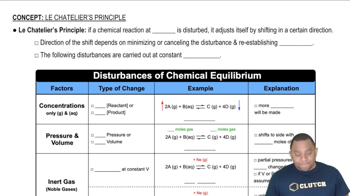
Le Chatelier's Principle

Le Chatelier's Principle states that if a dynamic equilibrium is disturbed by changing the conditions, the system will adjust to counteract the change and restore a new equilibrium. This principle helps predict how changes in temperature, pressure, or concentration will affect the position of equilibrium in a chemical reaction.
Video consigliato:
Percorso guidato
07:32
Le Chatelier's Principle

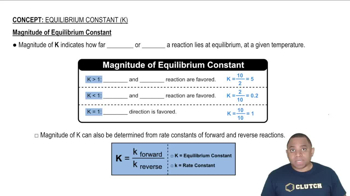
Temperature and Equilibrium Constant

The equilibrium constant (K) of a reaction is temperature-dependent. For exothermic reactions, increasing the temperature typically decreases K, while for endothermic reactions, increasing the temperature usually increases K. Understanding the nature of the reaction (exothermic or endothermic) is crucial to predicting how K will change with temperature.
Video consigliato:
Percorso guidato
02:33
Magnitude of Equilibrium Constant

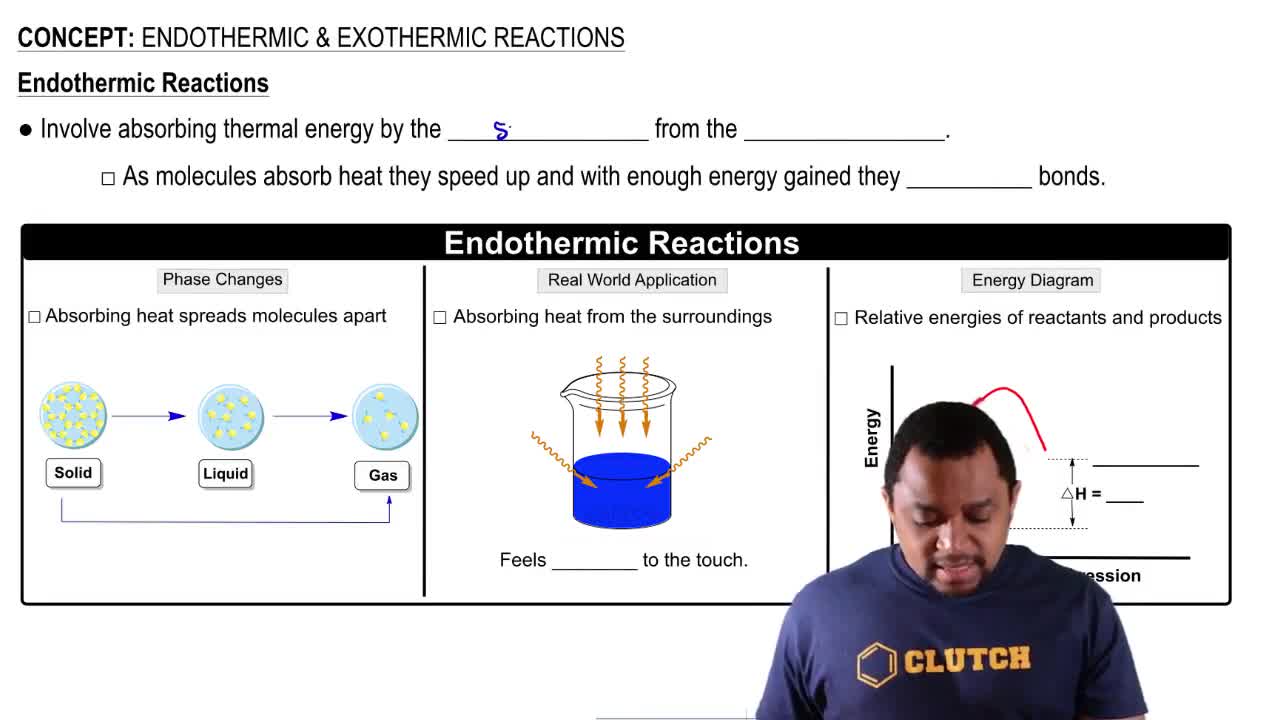
Exothermic and Endothermic Reactions

Exothermic reactions release heat, resulting in a negative change in enthalpy (ΔH < 0), while endothermic reactions absorb heat, leading to a positive change in enthalpy (ΔH > 0). The classification of a reaction as exothermic or endothermic is essential for determining how the equilibrium constant will respond to temperature changes.
Video consigliato:
Percorso guidato
02:30
Endothermic & Exothermic Reactions