Methanol (CH3OH) can be made by the reaction of CO with H2: CO(𝑔) + 2 H2(𝑔) ⇌ CH3OH(𝑔) (a) Use thermochemical data in Appendix C to calculate ΔH° for this reaction.
Ch.15 - Chemical Equilibrium
Brown14th EditionChemistry: The Central ScienceISBN: 9780134414232Non è quello che usi tu?Cambia libro di testo
Capitolo 15, Problema 66b
Methanol (CH3OH) can be made by the reaction of CO with H2: CO(𝑔) + 2 H2(𝑔) ⇌ CH3OH(𝑔) (b) To maximize the equilibrium yield of methanol, would you use a high or low temperature?
Guida verificata passo dopo passo1
Understand the nature of the reaction: The reaction CO(g) + 2 H2(g) ⇌ CH3OH(g) is an exothermic reaction, meaning it releases heat.
Recall Le Chatelier's Principle: This principle states that if a system at equilibrium is subjected to a change in concentration, temperature, volume, or pressure, then the system will adjust itself to counteract that change and restore a new equilibrium.
Apply Le Chatelier's Principle to temperature: Increasing the temperature of an exothermic reaction will shift the equilibrium to the left, favoring the reactants. Conversely, decreasing the temperature shifts the equilibrium to the right, favoring the formation of products.
Determine the effect of temperature on yield: Since the formation of methanol (CH3OH) is exothermic, lowering the temperature will shift the equilibrium towards the right, increasing the yield of methanol.
Conclusion on optimal conditions: To maximize the equilibrium yield of methanol in this reaction, a low temperature should be used.

Risposta video verificata per un problema simile:
Questa soluzione video è stata consigliata dai nostri tutor come utile per risolvere questo problema.
Durata del video:
5mConcetti chiave
Ecco i concetti essenziali che devi comprendere per rispondere correttamente alla domanda.
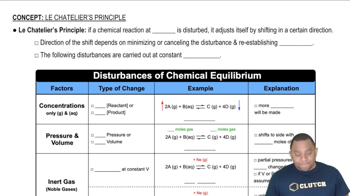
Le Chatelier's Principle
Le Chatelier's Principle states that if a dynamic equilibrium is disturbed by changing the conditions, the position of equilibrium shifts to counteract the change. In the context of the methanol synthesis reaction, altering temperature can influence the equilibrium position, favoring either the reactants or products depending on whether the reaction is exothermic or endothermic.
Video consigliato:
Percorso guidato
Le Chatelier's Principle
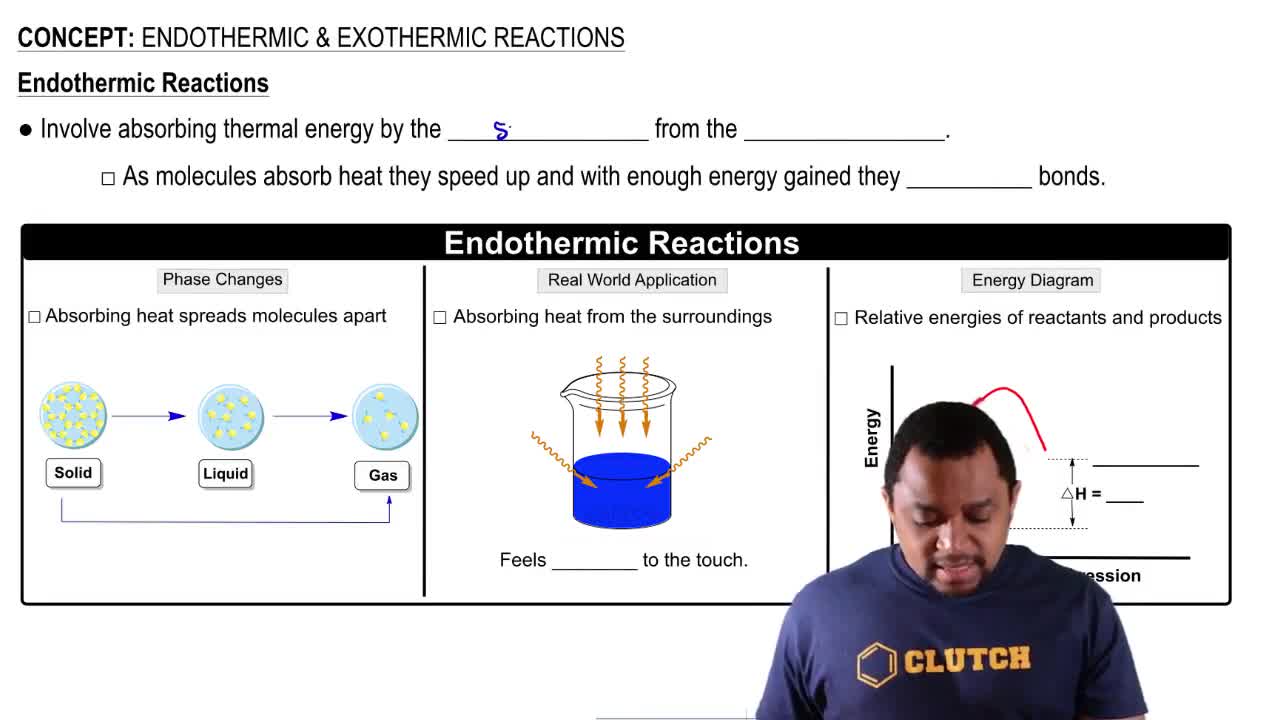
Exothermic and Endothermic Reactions
Reactions can be classified as exothermic or endothermic based on heat exchange. An exothermic reaction releases heat, while an endothermic reaction absorbs heat. The methanol synthesis reaction is exothermic, meaning that lowering the temperature would favor the formation of methanol, as the system will shift to produce more heat.
Video consigliato:
Percorso guidato
Endothermic & Exothermic Reactions
Equilibrium Constant (K)
The equilibrium constant (K) quantifies the ratio of concentrations of products to reactants at equilibrium for a given reaction at a specific temperature. Changes in temperature can alter the value of K, thus affecting the yield of products. For the methanol synthesis reaction, a lower temperature increases the equilibrium constant, favoring the production of methanol.
Video consigliato:
Percorso guidato
Equilibrium Constant K
Pratica correlata
Domanda del libro di testo
1098
views
Domanda del libro di testo
Consider the following equilibrium between oxides of nitrogen 3 NO(g) ⇌ NO2(g) + N2O(g) (a) Use data in Appendix C to calculate ΔH° for this reaction.
470
views
Domanda del libro di testo
The water–gas shift reaction CO1g2 + H2O1g2Δ
CO21g2 + H21g2 is used industrially to produce hydrogen.
The reaction enthalpy is H = -41 kJ.
(b) Could you increase the equilibrium yield
of hydrogen by controlling the pressure of this reaction? If
so would high or low pressure favor formation of H2(g)?
1407
views
1
rank
Domanda del libro di testo
Ozone, O3, decomposes to molecular oxygen in the stratosphere according to the reaction 2 O31g2¡3 O21g2. Would an increase in pressure favor the formation of ozone or of oxygen?
806
views
Domanda del libro di testo
Consider the following equilibrium between oxides of nitrogen
3 NO(g) ⇌ NO2(g) + N2O(g)
(c) At constant temperature, would a change in the volume of the container affect the fraction of products in the equilibrium mixture?
Domanda del libro di testo
Methanol (CH3OH) can be made by the reaction of CO with H2: CO(𝑔) + 2 H2(𝑔) ⇌ CH3OH(𝑔) (c) To maximize the equilibrium yield of methanol, would you use a high or low pressure?
435
views