Ch.15 - Chemical Equilibrium
Brown - Chemistry: The Central Science 14th Edition
Brown14th EditionChemistry: The Central ScienceISBN: 9780134414232Non è quello che usi tu?Cambia libro di testo
Capitolo 15, Problema 72

If Kc = 1 for the equilibrium 2A ⇌ B, what is the relationship between [A] and [B] at equilibrium?

Guida verificata passo dopo passo
1
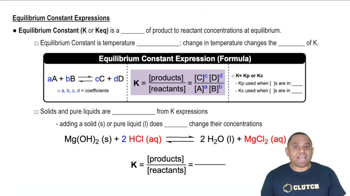
Step 1: Write the expression for the equilibrium constant (Kc) for the reaction 2A ⇌ B. The expression is Kc = \( \frac{[B]}{[A]^2} \).
Step 2: Since Kc = 1, set the expression equal to 1: \( \frac{[B]}{[A]^2} = 1 \).
Step 3: Rearrange the equation to express [B] in terms of [A]: [B] = [A]^2.
Step 4: Interpret the relationship: At equilibrium, the concentration of B is equal to the square of the concentration of A.
Step 5: Conclude that if Kc = 1, then [B] = [A]^2, indicating a specific mathematical relationship between the concentrations of A and B at equilibrium.

Concetti chiave

Ecco i concetti essenziali che devi comprendere per rispondere correttamente alla domanda.

Equilibrium Constant (Kc)

The equilibrium constant, Kc, is a numerical value that expresses the ratio of the concentrations of products to reactants at equilibrium for a given reaction at a specific temperature. For the reaction 2A ⇌ B, Kc is calculated as [B]/[A]^2. A Kc value of 1 indicates that at equilibrium, the concentrations of products and reactants are equal when raised to their respective stoichiometric coefficients.
Video consigliato:
Percorso guidato
03:20
Equilibrium Constant Expressions

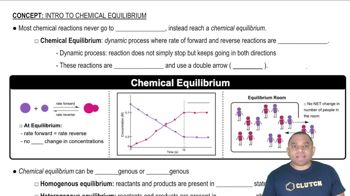
Chemical Equilibrium

Chemical equilibrium occurs when the rates of the forward and reverse reactions are equal, resulting in constant concentrations of reactants and products over time. In the context of the reaction 2A ⇌ B, this means that the concentrations of A and B will stabilize at certain values, reflecting the balance between the formation of B from A and the conversion of B back to A.
Video consigliato:
Percorso guidato
04:21
Chemical Equilibrium Concepts

Concentration Relationships at Equilibrium

At equilibrium, the concentrations of reactants and products are related through the equilibrium constant. For Kc = 1 in the reaction 2A ⇌ B, it implies that the concentration of B is equal to the square of the concentration of A, or [B] = [A]^2. This relationship helps predict how changes in concentration will affect the system and the position of equilibrium.
Video consigliato:
Percorso guidato
02:35
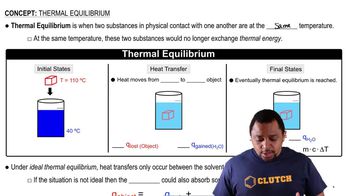
Thermal Equilibrium