Ch.15 - Chemical Equilibrium
Brown - Chemistry: The Central Science 14th Edition
Brown14th EditionChemistry: The Central ScienceISBN: 9780134414232Non è quello che usi tu?Cambia libro di testo
Capitolo 15, Problema 23

The equilibrium constant for the reaction 2 NO(g) + Br2(g) ⇌ 2 NOBr(g) is Kc = 1.3 * 10^-2 at 1000 K. (b) Calculate Kc for 2 NOBr(g) ⇌ 2 NO(g) + Br2(g). (c) Calculate Kc for NOBr(g) ⇌ NO(g) + 1/2 Br2(g).

Guida verificata passo dopo passo
1
Step 1: Understand that the equilibrium constant (Kc) for a reaction is related to the direction of the reaction. If the reaction is reversed, the new Kc is the reciprocal of the original Kc.
Step 2: For part (b), reverse the given reaction 2 NO(g) + Br2(g) ⇌ 2 NOBr(g) to get 2 NOBr(g) ⇌ 2 NO(g) + Br2(g). Calculate the new Kc by taking the reciprocal of the original Kc: Kc(new) = 1 / Kc(original).
Step 3: For part (c), modify the reaction 2 NOBr(g) ⇌ 2 NO(g) + Br2(g) to NOBr(g) ⇌ NO(g) + 1/2 Br2(g). Notice that this involves dividing the stoichiometric coefficients by 2.
Step 4: When the coefficients of a balanced equation are divided by a number, the equilibrium constant is raised to the power of that number. Therefore, calculate the new Kc for part (c) by taking the square root of the Kc obtained in part (b).
Step 5: Use the relationships from the previous steps to express the final Kc values for both parts (b) and (c) in terms of the original Kc.

Concetti chiave

Ecco i concetti essenziali che devi comprendere per rispondere correttamente alla domanda.

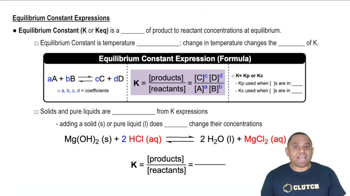
Equilibrium Constant (Kc)

The equilibrium constant (Kc) is a numerical value that expresses the ratio of the concentrations of products to reactants at equilibrium for a given chemical reaction at a specific temperature. It is calculated using the formula Kc = [products]^[coefficients] / [reactants]^[coefficients]. A larger Kc indicates a greater concentration of products at equilibrium, while a smaller Kc suggests a higher concentration of reactants.
Video consigliato:
Percorso guidato
03:20
Equilibrium Constant Expressions

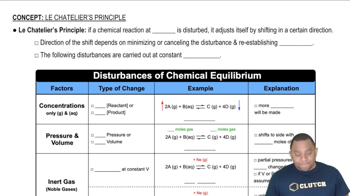
Le Chatelier's Principle

Le Chatelier's Principle states that if a dynamic equilibrium is disturbed by changing the conditions, the system will adjust itself to counteract the change and restore a new equilibrium. This principle is crucial for understanding how changes in concentration, pressure, or temperature affect the position of equilibrium and, consequently, the value of Kc for a reaction.
Video consigliato:
Percorso guidato
07:32
Le Chatelier's Principle

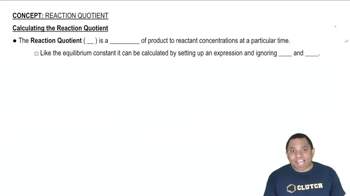
Reaction Quotient (Q)

The reaction quotient (Q) is a measure of the relative amounts of products and reactants present in a reaction at any point in time, not just at equilibrium. It is calculated similarly to Kc but uses the current concentrations. Comparing Q to Kc helps predict the direction in which a reaction will proceed to reach equilibrium: if Q < Kc, the reaction will shift to the right (toward products), and if Q > Kc, it will shift to the left (toward reactants).
Video consigliato:
Percorso guidato
00:49
Reaction Quotient Q