Ch.15 - Chemical Equilibrium
Brown - Chemistry: The Central Science 14th Edition
Brown14th EditionChemistry: The Central ScienceISBN: 9780134414232Non è quello che usi tu?Cambia libro di testo
Capitolo 15, Problema 19c

Which of the following statements are true and which are false? (c) As the value of the equilibrium constant increases, the speed at which a reaction reaches equilibrium must increase.

Guida verificata passo dopo passo
1
Step 1: Understand the concept of equilibrium constant (K). The equilibrium constant is a measure of the ratio of the concentrations of products to reactants at equilibrium. It does not depend on the initial concentrations of reactants or products and is only affected by temperature.
Step 2: Understand the concept of reaction rate. The speed at which a reaction reaches equilibrium is determined by the reaction rate, not the equilibrium constant. The reaction rate is influenced by factors such as temperature, concentration, and the presence of a catalyst.
Step 3: Analyze the statement. The statement suggests that as the value of the equilibrium constant increases, the speed at which a reaction reaches equilibrium must increase. This is implying a direct relationship between the equilibrium constant and the reaction rate.
Step 4: Evaluate the statement. The equilibrium constant (K) and the reaction rate are independent of each other. A larger equilibrium constant means the reaction favors the products at equilibrium, but it does not necessarily mean the reaction will reach equilibrium faster.
Step 5: Conclude the statement. Therefore, the statement is false. The speed at which a reaction reaches equilibrium (reaction rate) is not directly related to the value of the equilibrium constant.

Risposta video verificata per un problema simile:

Questa soluzione video è stata consigliata dai nostri tutor come utile per risolvere questo problema.
Durata del video:
2m

Concetti chiave

Ecco i concetti essenziali che devi comprendere per rispondere correttamente alla domanda.

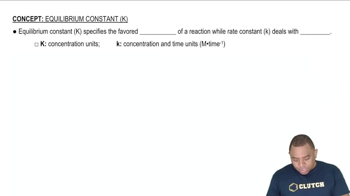
Equilibrium Constant (K)

The equilibrium constant (K) is a numerical value that expresses the ratio of the concentrations of products to reactants at equilibrium for a reversible chemical reaction. A larger K value indicates a greater concentration of products at equilibrium, suggesting that the reaction favors product formation. However, K does not provide information about the rate at which equilibrium is achieved.
Video consigliato:
Percorso guidato
01:14
Equilibrium Constant K

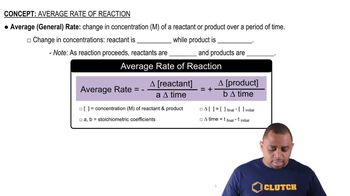
Reaction Rate

The reaction rate refers to the speed at which reactants are converted into products in a chemical reaction. It is influenced by factors such as concentration, temperature, and the presence of catalysts. While the equilibrium constant indicates the position of equilibrium, it does not directly correlate with how quickly a reaction reaches that state.
Video consigliato:
Percorso guidato
02:03
Average Rate of Reaction

Dynamic Equilibrium

Dynamic equilibrium occurs in a reversible reaction when the rates of the forward and reverse reactions are equal, resulting in constant concentrations of reactants and products. This state does not imply that the reaction has stopped; rather, it continues to occur in both directions at equal rates. The time taken to reach this equilibrium can vary independently of the equilibrium constant.
Video consigliato:
Percorso guidato
01:18
Chemical Equilibrium Example