Ch.15 - Chemical Equilibrium
Brown - Chemistry: The Central Science 14th Edition
Brown14th EditionChemistry: The Central ScienceISBN: 9780134414232Non è quello che usi tu?Cambia libro di testo
Capitolo 15, Problema 19a,b

Which of the following statements are true and which are false? (a) The equilibrium constant can never be a negative number. (b) In reactions that we draw with a single-headed arrow, the equilibrium constant has a value that is very close to zero.

Guida verificata passo dopo passo
1
Step 1: Understand the concept of the equilibrium constant (K). The equilibrium constant is a ratio of the concentration of products to reactants at equilibrium, raised to the power of their stoichiometric coefficients. It is expressed as \( K = \frac{[C]^c[D]^d}{[A]^a[B]^b} \) for a general reaction \( aA + bB \rightleftharpoons cC + dD \).
Step 2: Evaluate statement (a). The equilibrium constant \( K \) is derived from concentrations or partial pressures, which are always positive values. Therefore, \( K \) itself cannot be negative. Consider why negative concentrations or pressures are not physically meaningful.
Step 3: Evaluate statement (b). A single-headed arrow in a chemical equation typically indicates a reaction that goes to completion, meaning it is not reversible under the given conditions. In such cases, the equilibrium constant is not close to zero; instead, it is very large, indicating that the reaction favors the formation of products.
Step 4: Consider the implications of a very large equilibrium constant. If \( K \) is very large, it suggests that the concentration of products is much greater than that of reactants at equilibrium, which aligns with the concept of a single-headed arrow indicating a reaction that proceeds to completion.
Step 5: Summarize the analysis. Statement (a) is true because the equilibrium constant cannot be negative. Statement (b) is false because a single-headed arrow indicates a reaction that goes to completion, resulting in a large equilibrium constant, not one close to zero.

Concetti chiave

Ecco i concetti essenziali che devi comprendere per rispondere correttamente alla domanda.

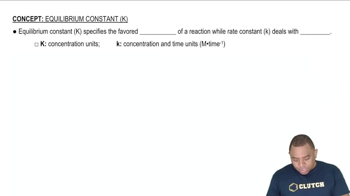
Equilibrium Constant

The equilibrium constant (K) is a numerical value that expresses the ratio of the concentrations of products to reactants at equilibrium for a given reaction at a specific temperature. It is always a positive value because it is derived from concentrations, which cannot be negative. A K value greater than one indicates that products are favored, while a value less than one indicates that reactants are favored.
Video consigliato:
Percorso guidato
01:14
Equilibrium Constant K

Single-Headed Arrow in Reactions

A single-headed arrow in a chemical equation indicates a reaction that goes to completion, meaning that the reactants are converted entirely into products without any significant reverse reaction. In such cases, the equilibrium constant is typically very large, not close to zero, as the products dominate the reaction mixture. This contrasts with reversible reactions, which are represented with double-headed arrows.
Video consigliato:
Percorso guidato
01:11
Single Displacement Reactions

True/False Statements in Chemistry

Evaluating true or false statements in chemistry often requires a solid understanding of fundamental principles and definitions. In this context, recognizing the nature of equilibrium constants and the implications of reaction arrows is essential. Misinterpretations can lead to incorrect conclusions, so careful analysis of the statements based on established chemical concepts is crucial.
Video consigliato:
Percorso guidato
01:29
Introduction to Organic Chemistry Example