Consider the molecular models shown here, where X represents a halogen atom. (a) If X is the same atom in both molecules, which molecule will be more acidic?
Ch.16 - Acid-Base Equilibria
Brown14th EditionChemistry: The Central ScienceISBN: 9780134414232Non è quello che usi tu?Cambia libro di testo
Capitolo 16, Problema 13
NH31g2 and HCl(g) react to form the ionic solid NH4Cl1s2. Which substance is the Brønsted–Lowry acid in this reaction? Which is the Brønsted–Lowry base?
Guida verificata passo dopo passo1
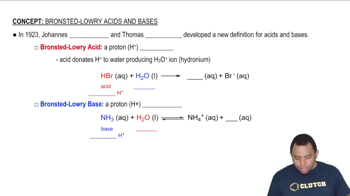
Identify the Brønsted–Lowry acid and base definitions: A Brønsted–Lowry acid is a substance that donates a proton (H+), while a Brønsted–Lowry base is a substance that accepts a proton.
Examine the reactants: NH3(g) and HCl(g).
Determine which substance donates a proton: HCl(g) donates a proton to form Cl- and NH4+.
Determine which substance accepts a proton: NH3(g) accepts a proton to form NH4+.
Conclude that HCl(g) is the Brønsted–Lowry acid (proton donor) and NH3(g) is the Brønsted–Lowry base (proton acceptor).

Risposta video verificata per un problema simile:
Questa soluzione video è stata consigliata dai nostri tutor come utile per risolvere questo problema.
Durata del video:
2mConcetti chiave
Ecco i concetti essenziali che devi comprendere per rispondere correttamente alla domanda.
Brønsted–Lowry Acid-Base Theory
The Brønsted–Lowry theory defines acids as proton donors and bases as proton acceptors. In a chemical reaction, the substance that donates a hydrogen ion (H+) is classified as an acid, while the substance that accepts the hydrogen ion is classified as a base. This theory expands the definition of acids and bases beyond just their behavior in water, allowing for a broader understanding of acid-base reactions.
Video consigliato:
Percorso guidato
Bronsted-Lowry Acid-Base Theory
Ionic Compounds
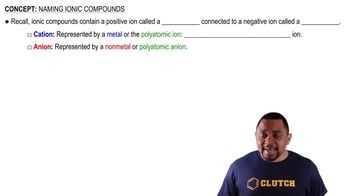
Ionic compounds are formed through the electrostatic attraction between positively charged ions (cations) and negatively charged ions (anions). In the context of the reaction between NH3 and HCl, the product NH4Cl is an ionic compound where NH4+ acts as the cation and Cl- as the anion. Understanding the formation of ionic compounds is essential for analyzing the products of acid-base reactions.
Video consigliato:
Percorso guidato
Ionic Compounds Naming
Reaction Mechanism
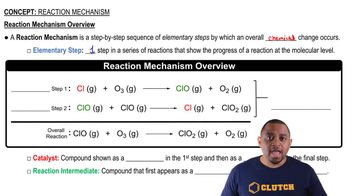
The reaction mechanism describes the step-by-step process by which reactants transform into products. In the case of NH3 and HCl, the mechanism involves the transfer of a proton from HCl to NH3, resulting in the formation of NH4+ and Cl-. Analyzing the mechanism helps identify the roles of each reactant, clarifying which is the acid and which is the base in the reaction.
Video consigliato:
Percorso guidato
Reaction Mechanism Overview
Pratica correlata
Domanda del libro di testo
415
views
Domanda del libro di testo
Give the conjugate base of the following Brønsted–Lowry acids: (i) HIO3, (ii) NH4+.
415
views
Domanda del libro di testo
Which of the following statements is false? (a) An Arrhenius base increases the concentration of OH- in water. (b) A Brønsted-Lowry base is a proton acceptor. (c) Water can act as a Brønsted–Lowry acid. (d) Water can act as a Brønsted–Lowry base. (e) Any compound that contains an –OH group acts as a Brønsted-Lowry base.
519
views
Domanda del libro di testo
Give the conjugate base of the following Brønsted–Lowry acids: (i) HCOOH, (ii) HPO42-.
511
views
Domanda del libro di testo
Consider the molecular models shown here, where X represents a halogen atom. (b) Does the acidity of each molecule increase or decrease as the electronegativity of the atom X increases?
330
views