Ch.16 - Acid-Base Equilibria
Brown - Chemistry: The Central Science 14th Edition
Brown14th EditionChemistry: The Central ScienceISBN: 9780134414232Non è quello che usi tu?Cambia libro di testo
Capitolo 16, Problema 14

Which of the following statements is false? (a) An Arrhenius base increases the concentration of OH- in water. (b) A Brønsted-Lowry base is a proton acceptor. (c) Water can act as a Brønsted–Lowry acid. (d) Water can act as a Brønsted–Lowry base. (e) Any compound that contains an –OH group acts as a Brønsted-Lowry base.

Guida verificata passo dopo passo
1
Identify the definitions of Arrhenius and Brønsted-Lowry acids and bases.
Recall that an Arrhenius base increases the concentration of OH^- ions in water.
Understand that a Brønsted-Lowry base is defined as a proton (H^+) acceptor.
Recognize that water (H2O) can act as both a Brønsted-Lowry acid (proton donor) and a Brønsted-Lowry base (proton acceptor).
Evaluate the statement that any compound with an –OH group acts as a Brønsted-Lowry base, and consider exceptions such as alcohols, which do not typically act as bases.

Risposta video verificata per un problema simile:

Questa soluzione video è stata consigliata dai nostri tutor come utile per risolvere questo problema.
Durata del video:
3m

Concetti chiave

Ecco i concetti essenziali che devi comprendere per rispondere correttamente alla domanda.

Arrhenius Theory of Acids and Bases

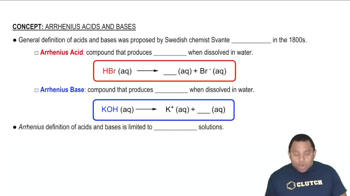
The Arrhenius theory defines acids as substances that increase the concentration of hydrogen ions (H+) in aqueous solution, while bases increase the concentration of hydroxide ions (OH-). This theory is foundational in understanding the behavior of acids and bases in water, particularly in identifying how they dissociate and interact in solution.
Video consigliato:
Percorso guidato
02:00
Arrhenius Acids and Bases

Brønsted-Lowry Theory of Acids and Bases

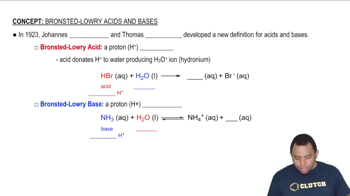
The Brønsted-Lowry theory expands the definition of acids and bases beyond aqueous solutions. According to this theory, an acid is a proton donor and a base is a proton acceptor. This concept allows for a broader understanding of acid-base reactions, including those that occur in non-aqueous environments.
Video consigliato:
Percorso guidato
02:08
Bronsted-Lowry Acid-Base Theory

Amphoteric Substances

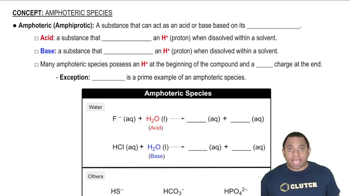
Amphoteric substances are those that can act as either an acid or a base depending on the context of the reaction. Water is a prime example, as it can donate a proton (acting as an acid) or accept a proton (acting as a base). Understanding this dual behavior is crucial for analyzing reactions involving water and other amphoteric compounds.
Video consigliato:
Percorso guidato
03:03
Amphoteric Species