Ch.16 - Acid-Base Equilibria
Brown - Chemistry: The Central Science 14th Edition
Brown14th EditionChemistry: The Central ScienceISBN: 9780134414232Non è quello che usi tu?Cambia libro di testo
Capitolo 16, Problema 61

Saccharin, a sugar substitute, is a weak acid with pKa = 2.32 at 25 °C. It ionizes in aqueous solution as follows: HNC7H4SO31(aq) ⇌ H+(aq) + NC7H4SO3-(aq). What is the pH of a 0.10 M solution of this substance?

Guida verificata passo dopo passo
1
Identify the given information: The concentration of saccharin is 0.10 M, and the pKa is 2.32.
Use the relationship between pKa and Ka: \( \text{pKa} = -\log_{10}(K_a) \). Calculate \( K_a \) by rearranging the formula to \( K_a = 10^{-\text{pKa}} \).
Set up the expression for the ionization of saccharin: \( K_a = \frac{[H^+][NC_7H_4SO_3^-]}{[HNC_7H_4SO_3]} \). Assume \([H^+] = [NC_7H_4SO_3^-] = x\) and \([HNC_7H_4SO_3] = 0.10 - x\).
Substitute the expressions into the \( K_a \) equation: \( K_a = \frac{x^2}{0.10 - x} \). Since \( K_a \) is small, assume \( x \ll 0.10 \), simplifying to \( K_a \approx \frac{x^2}{0.10} \).
Solve for \( x \) (which is \([H^+]\)) using the simplified equation: \( x = \sqrt{K_a \times 0.10} \). Finally, calculate the pH using \( \text{pH} = -\log_{10}(x) \).

Concetti chiave

Ecco i concetti essenziali che devi comprendere per rispondere correttamente alla domanda.

pKa and pH Relationship

The pKa value of an acid indicates its strength; a lower pKa means a stronger acid. The pH of a solution is a measure of the concentration of hydrogen ions (H+) in that solution. The relationship between pKa and pH is crucial for understanding how much of the acid will ionize in solution, which directly affects the pH.
Video consigliato:
Percorso guidato
02:09
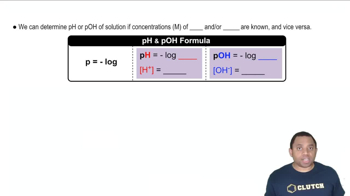
pH and pOH Calculations

Weak Acid Ionization

Weak acids do not completely dissociate in solution, establishing an equilibrium between the undissociated acid and its ions. The ionization of saccharin can be represented by the equilibrium expression, which allows us to calculate the concentration of H+ ions produced. This is essential for determining the pH of the solution.
Video consigliato:
Percorso guidato
01:15
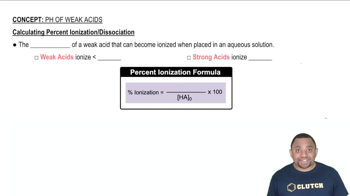
Calculating Percent Ionization of Weak Acids

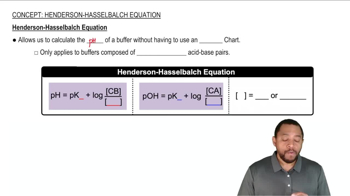
Henderson-Hasselbalch Equation

The Henderson-Hasselbalch equation relates the pH of a solution to the pKa of the acid and the ratio of the concentrations of the deprotonated and protonated forms. It is expressed as pH = pKa + log([A-]/[HA]). This equation is particularly useful for calculating the pH of weak acid solutions, such as saccharin, by incorporating the concentrations of the ionized and non-ionized forms.
Video consigliato:
Percorso guidato
02:40
Henderson-Hasselbalch Equation