Ch.17 - Additional Aspects of Aqueous Equilibria
Brown - Chemistry: The Central Science 14th Edition
Brown14th EditionChemistry: The Central ScienceISBN: 9780134414232Non è quello che usi tu?Cambia libro di testo
Capitolo 17, Problema 28

A buffer contains 0.15 mol of propionic acid (C2H5COOH) and 0.10 mol of sodium propionate (C2H5COONa) in 1.20 L. (a) What is the pH of this buffer? (b) What is the pH of the buffer after the addition of 0.01 mol of NaOH? (c) What is the pH of the buffer after the addition of 0.01 mol of HI?

Guida verificata passo dopo passo
1
Step 1: Identify the components of the buffer system. The buffer consists of propionic acid (C_2H_5COOH) and its conjugate base, sodium propionate (C_2H_5COONa).
Step 2: Use the Henderson-Hasselbalch equation to find the initial pH of the buffer. The equation is pH = pKa + \(\log\)\(\left\)(\(\frac{[\text{A}\)^-]}{[\(\text{HA}\)]\(\right\)), where [A^-] is the concentration of the conjugate base and [HA] is the concentration of the acid.
Step 3: Calculate the concentrations of propionic acid and sodium propionate in the buffer. Divide the moles of each by the volume of the solution (1.20 L) to find their molar concentrations.
Step 4: For part (b), determine the effect of adding 0.01 mol of NaOH. NaOH will react with the propionic acid, decreasing its concentration and increasing the concentration of the conjugate base. Adjust the concentrations accordingly and use the Henderson-Hasselbalch equation to find the new pH.
Step 5: For part (c), determine the effect of adding 0.01 mol of HI. HI will react with the sodium propionate, decreasing its concentration and increasing the concentration of the propionic acid. Adjust the concentrations accordingly and use the Henderson-Hasselbalch equation to find the new pH.

Concetti chiave

Ecco i concetti essenziali che devi comprendere per rispondere correttamente alla domanda.

Buffer Solutions

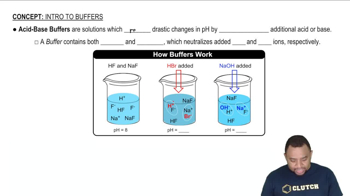
A buffer solution is a system that resists changes in pH upon the addition of small amounts of acid or base. It typically consists of a weak acid and its conjugate base, which work together to neutralize added acids or bases. In this case, propionic acid and sodium propionate form a buffer that maintains a relatively stable pH.
Video consigliato:
Percorso guidato
03:02
Buffer Solutions

Henderson-Hasselbalch Equation

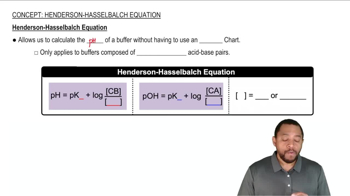
The Henderson-Hasselbalch equation is a mathematical formula used to calculate the pH of a buffer solution. It is expressed as pH = pKa + log([A-]/[HA]), where pKa is the negative logarithm of the acid dissociation constant, [A-] is the concentration of the conjugate base, and [HA] is the concentration of the weak acid. This equation is essential for determining the pH of the buffer before and after the addition of acids or bases.
Video consigliato:
Percorso guidato
02:40
Henderson-Hasselbalch Equation

Effect of Strong Acids and Bases on Buffers

When a strong acid (like HI) or a strong base (like NaOH) is added to a buffer, it can affect the pH depending on the amount added relative to the buffer's capacity. A strong base will react with the weak acid in the buffer, decreasing its concentration and increasing pH, while a strong acid will react with the conjugate base, decreasing its concentration and lowering pH. Understanding these interactions is crucial for predicting pH changes in buffer solutions.
Video consigliato:
Percorso guidato
01:09
Strong Acid-Strong Base Titration