
Ch.17 - Additional Aspects of Aqueous Equilibria
Brown - Chemistry: The Central Science 14th Edition
Brown14th EditionChemistry: The Central ScienceISBN: 9780134414232Non è quello che usi tu?Cambia libro di testo
Capitolo 17, Problema 10b

Ca1OH22 has a Ksp of 6.5 * 10-6. (b) If 50 mL of the solution from part (a) is added to each of the beakers shown here, in which beakers, if any, will a precipitate form? In those cases where a precipitate forms, what is its identity? [Section 17.6]
Four beakers labeled (i) to (iv) with different solutions for precipitation analysis.

Guida verificata passo dopo passo
1
Determine the concentration of Ca1OH22 in the 50 mL solution from part (a).
Calculate the moles of Ca1OH22 in the 50 mL solution using the concentration and volume.
Identify the ions present in each beaker and their initial concentrations before mixing with the Ca1OH22 solution.
Calculate the final concentrations of the ions after mixing the 50 mL Ca1OH22 solution with the 75 mL solutions in each beaker.
Compare the ion product (Q) with the Ksp value of Ca1OH22 to determine if a precipitate will form in each beaker. If Q > Ksp, a precipitate will form, and identify the precipitate.

Risposta video verificata per un problema simile:

Questa soluzione video è stata consigliata dai nostri tutor come utile per risolvere questo problema.
Durata del video:
17m

Concetti chiave

Ecco i concetti essenziali che devi comprendere per rispondere correttamente alla domanda.

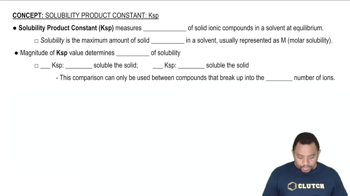
Solubility Product Constant (Ksp)

The solubility product constant (Ksp) is an equilibrium constant that applies to the solubility of sparingly soluble ionic compounds. It quantifies the extent to which a compound can dissolve in water, expressed as the product of the molar concentrations of its constituent ions, each raised to the power of their coefficients in the balanced equation. For calcium hydroxide, Ca(OH)2, a Ksp of 6.5 x 10^-6 indicates that at equilibrium, the product of the concentrations of Ca²⁺ and OH⁻ ions will equal this value.
Video consigliato:
Percorso guidato
01:47
Solubility Product Constant

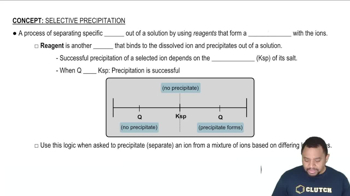
Precipitation Reaction

A precipitation reaction occurs when two soluble salts react in solution to form an insoluble compound, known as a precipitate. This process is driven by the formation of a product that has a lower solubility than the reactants. To determine if a precipitate will form, one must compare the ion product (Q) of the solution to the Ksp; if Q exceeds Ksp, a precipitate will form. In this case, the addition of Ca(OH)2 to the beakers will be analyzed for potential precipitate formation.
Video consigliato:
Percorso guidato
01:53
Selective Precipitation

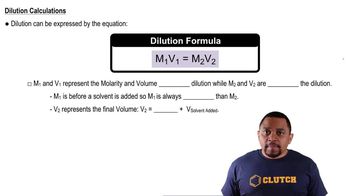
Ion Concentration and Dilution

Ion concentration refers to the amount of a specific ion present in a solution, typically expressed in molarity (M). When solutions are mixed, the total volume increases, which can dilute the concentrations of the ions involved. The dilution factor can be calculated using the formula C1V1 = C2V2, where C is concentration and V is volume. Understanding how dilution affects ion concentrations is crucial for predicting whether the conditions will lead to precipitation in the beakers.
Video consigliato:
Percorso guidato
00:58
Dilution Equation