
Ch.17 - Additional Aspects of Aqueous Equilibria
Brown - Chemistry: The Central Science 14th Edition
Brown14th EditionChemistry: The Central ScienceISBN: 9780134414232Non è quello che usi tu?Cambia libro di testo
Capitolo 17, Problema 9a

The following graphs represent the behavior of BaCO3 under different circumstances. In each case, the vertical axis indicates the solubility of the BaCO3 and the horizontal axis represents the concentration of some other reagent. (a) Which graph represents what happens to the solubility of BaCO3 as HNO3 is added? [Section 17.5]
Three graphs showing BaCO3 solubility vs. concentration under different conditions.

Guida verificata passo dopo passo
1
Identify the chemical reaction involved: BaCO3(s) + 2HNO3(aq) -> Ba(NO3)2(aq) + CO2(g) + H2O(l).
Understand that adding HNO3 will increase the solubility of BaCO3 because HNO3 reacts with BaCO3 to form soluble Ba(NO3)2.
Analyze the graphs: Graph A shows an increase in solubility with increasing concentration, Graph B shows a decrease, and Graph C shows no change.
Determine that Graph A represents the solubility behavior of BaCO3 as HNO3 is added, since solubility increases with the addition of HNO3.
Conclude that the correct graph is Graph A, which shows the solubility of BaCO3 increasing with the concentration of HNO3.

Risposta video verificata per un problema simile:

Questa soluzione video è stata consigliata dai nostri tutor come utile per risolvere questo problema.
Durata del video:
6m

Concetti chiave

Ecco i concetti essenziali che devi comprendere per rispondere correttamente alla domanda.

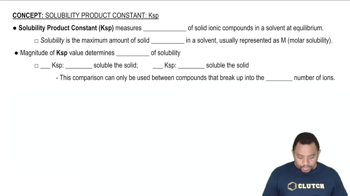
Solubility Product Constant (Ksp)

The solubility product constant (Ksp) is an equilibrium constant that applies to the solubility of sparingly soluble ionic compounds. It quantifies the extent to which a compound can dissolve in a solvent, represented by the product of the molar concentrations of its ions, each raised to the power of their coefficients in the balanced equation. Understanding Ksp is crucial for predicting how changes in concentration of other reagents, like HNO3, affect the solubility of BaCO3.
Video consigliato:
Percorso guidato
01:47
Solubility Product Constant

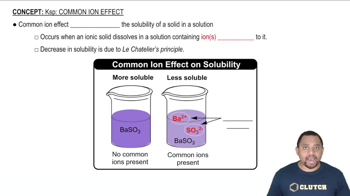
Common Ion Effect

The common ion effect describes the decrease in solubility of an ionic compound when a common ion is added to the solution. For BaCO3, adding HNO3 introduces H+ ions, which can shift the equilibrium and affect the solubility of BaCO3. This principle is essential for interpreting how the addition of HNO3 influences the solubility of BaCO3 in the provided graphs.
Video consigliato:
Percorso guidato
02:53
Common Ion Effect

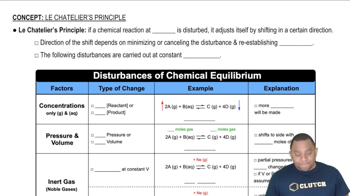
Le Chatelier's Principle

Le Chatelier's Principle states that if a dynamic equilibrium is disturbed by changing the conditions, the system will adjust to counteract the change and restore a new equilibrium. In the context of BaCO3 solubility, adding HNO3 alters the concentration of ions in solution, prompting a shift in the equilibrium position that can either increase or decrease the solubility of BaCO3, depending on the specific conditions.
Video consigliato:
Percorso guidato
07:32
Le Chatelier's Principle