Ch.17 - Additional Aspects of Aqueous Equilibria
Brown - Chemistry: The Central Science 14th Edition
Brown14th EditionChemistry: The Central ScienceISBN: 9780134414232Non è quello che usi tu?Cambia libro di testo
Capitolo 17, Problema 12

Three cations, Ni2+ , Cu2+ , and Ag+, are separated using two different precipitating agents. Based on Figure 17.23, what two precipitating agents could be used? Using these agents, indicate which of the cations is A, which is B, and which is C.[Section 17.7]

Guida verificata passo dopo passo
1
Identify the solubility rules and common precipitating agents for the cations Ni2+, Cu2+, and Ag+ from the textbook or reliable chemistry resources.
Consult Figure 17.23 to observe the behavior of each cation with different precipitating agents. Note which agents cause precipitation with which cations.
Select two precipitating agents that can effectively separate the three cations based on their ability to selectively precipitate one or more of the cations while leaving others in solution.
Assign the labels A, B, and C to the cations Ni2+, Cu2+, and Ag+ based on the order of their precipitation or remaining in solution as indicated in Figure 17.23.
Summarize the separation process, detailing which cation precipitates with which agent and the sequence of adding these agents to achieve complete separation.

Risposta video verificata per un problema simile:

Questa soluzione video è stata consigliata dai nostri tutor come utile per risolvere questo problema.
Durata del video:
3m

Concetti chiave

Ecco i concetti essenziali che devi comprendere per rispondere correttamente alla domanda.

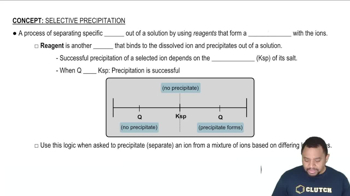
Precipitation Reactions

Precipitation reactions occur when two soluble salts react to form an insoluble compound, known as a precipitate. This process is driven by the formation of a solid that separates from the solution, which can be influenced by factors such as solubility rules and the concentrations of the reactants. Understanding these reactions is crucial for identifying which cations can be separated using specific precipitating agents.
Video consigliato:
Percorso guidato
01:53
Selective Precipitation

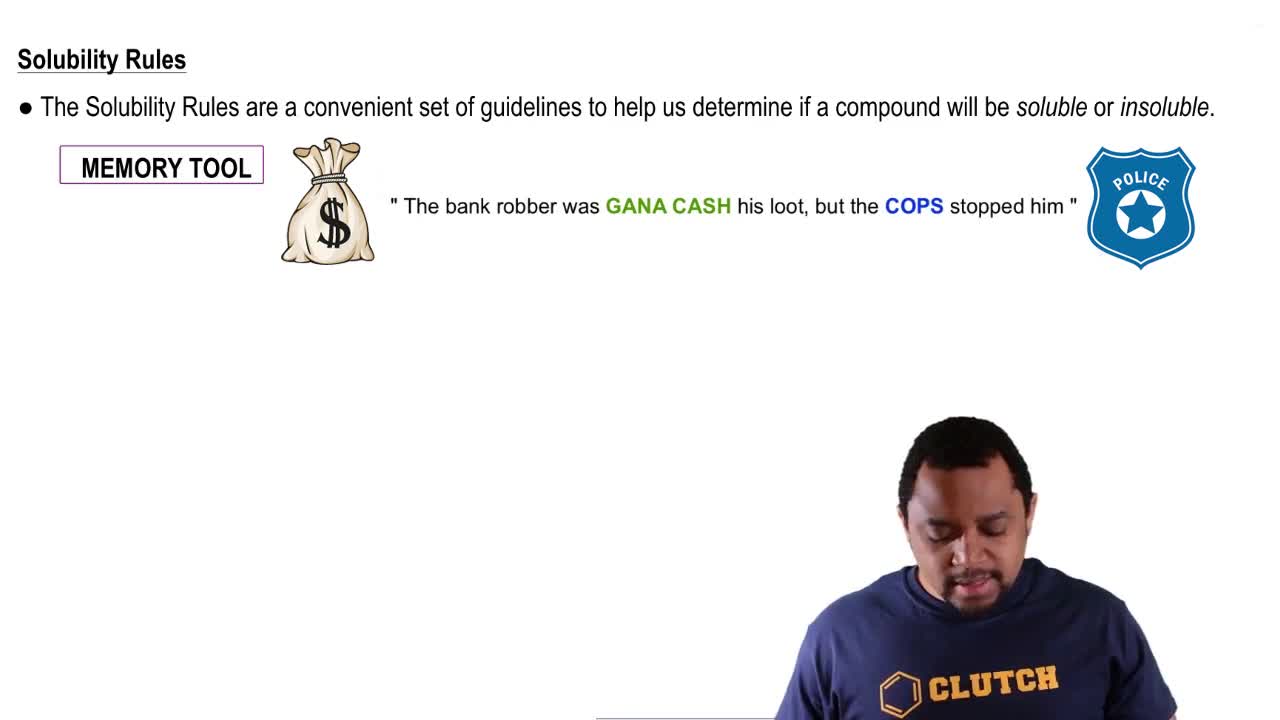
Solubility Rules

Solubility rules are guidelines that predict the solubility of various ionic compounds in water. These rules help chemists determine which compounds will remain dissolved and which will precipitate out of solution. For the cations Ni<sup>2+</sup>, Cu<sup>2+</sup>, and Ag<sup>+</sup>, knowing their solubility with different anions is essential for selecting appropriate precipitating agents.
Video consigliato:
Percorso guidato
00:28
Solubility Rules

Cation Identification

Cation identification involves using specific tests or reactions to distinguish between different cations in a mixture. This can be achieved through selective precipitation, where certain cations are precipitated out using specific reagents, allowing for their identification based on the order of precipitation and the characteristics of the resulting precipitates. This concept is key to solving the question regarding which cation corresponds to which precipitating agent.
Video consigliato:
Percorso guidato
00:31
Cation Solubility