
Ch.19 - Chemical Thermodynamics
Brown - Chemistry: The Central Science 14th Edition
Brown14th EditionChemistry: The Central ScienceISBN: 9780134414232Non è quello che usi tu?Cambia libro di testo
Capitolo 19, Problema 63c

Classify each of the following reactions as one of the four possible types summarized in Table 19.3: (i) spontaneous at all temperatures; (ii) not spontaneous at any temperature; (iii) spontaneous at low T but not spontaneous at high T; (iv) spontaneous at high T but not spontaneous at low T.
(c) N2F4(g) ⟶ 2 NF2(g) ΔH° = 85 kJ; ΔS° = 198 J/K

Guida verificata passo dopo passo
1
Identify the given values: \( \Delta H^\circ = 85 \text{ kJ} \) and \( \Delta S^\circ = 198 \text{ J/K} \).
Convert \( \Delta S^\circ \) from \( \text{J/K} \) to \( \text{kJ/K} \) by dividing by 1000, so \( \Delta S^\circ = 0.198 \text{ kJ/K} \).
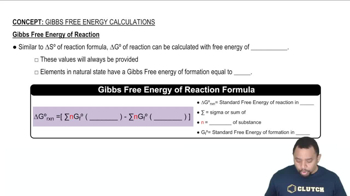
Use the Gibbs free energy equation: \( \Delta G^\circ = \Delta H^\circ - T \Delta S^\circ \).
Determine the sign of \( \Delta G^\circ \) at different temperatures: \( \Delta G^\circ \) is positive when \( \Delta H^\circ > T \Delta S^\circ \) and negative when \( \Delta H^\circ < T \Delta S^\circ \).
Since \( \Delta H^\circ > 0 \) and \( \Delta S^\circ > 0 \), the reaction is spontaneous at high temperatures but not at low temperatures.

Risposta video verificata per un problema simile:

Questa soluzione video è stata consigliata dai nostri tutor come utile per risolvere questo problema.
Durata del video:
1m

Concetti chiave

Ecco i concetti essenziali che devi comprendere per rispondere correttamente alla domanda.

Gibbs Free Energy

Gibbs Free Energy (G) is a thermodynamic potential that helps predict the spontaneity of a reaction at constant temperature and pressure. The change in Gibbs Free Energy (ΔG) is calculated using the equation ΔG = ΔH - TΔS, where ΔH is the change in enthalpy, T is the temperature in Kelvin, and ΔS is the change in entropy. A negative ΔG indicates a spontaneous reaction, while a positive ΔG suggests non-spontaneity.
Video consigliato:
Percorso guidato
01:51
Gibbs Free Energy of Reactions

Enthalpy and Entropy

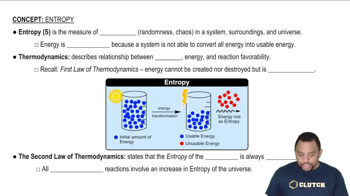
Enthalpy (ΔH) is a measure of the total heat content of a system, while entropy (ΔS) quantifies the degree of disorder or randomness in a system. In chemical reactions, the balance between enthalpy and entropy changes determines whether a reaction is spontaneous. For example, reactions that release heat (exothermic, ΔH < 0) and increase disorder (ΔS > 0) are typically spontaneous.
Video consigliato:
Percorso guidato
02:46
Entropy in Thermodynamics

Temperature Dependence of Spontaneity

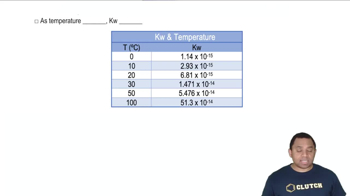
The spontaneity of a reaction can depend on temperature, as indicated by the Gibbs Free Energy equation. At low temperatures, reactions with negative ΔH and positive ΔS are favored, while at high temperatures, reactions with positive ΔS can become spontaneous even if ΔH is positive. Understanding this temperature dependence is crucial for classifying reactions into the four types of spontaneity.
Video consigliato:
Percorso guidato
01:24
Kw Temperature Dependence