
Ch.19 - Chemical Thermodynamics
Brown - Chemistry: The Central Science 14th Edition
Brown14th EditionChemistry: The Central ScienceISBN: 9780134414232Non è quello che usi tu?Cambia libro di testo
Capitolo 19, Problema 64

From the values given for ΔH° and ΔS°, calculate ΔG° for each of the following reactions at 298 K. If the reaction is not spontaneous under standard conditions at 298 K, at what temperature (if any) would the reaction become spontaneous?
a. 2 PbS(s) + 3 O2(g) → 2 PbO(s) + 2 SO2(g) ΔH° = −844 kJ; ΔS° = −165 J/K
b. 2 POCl3(g) → 2 PCl3(g) + O2(g) ΔH° = 572 kJ; ΔS° = 179 J/K

Guida verificata passo dopo passo
1
Step 1: Convert the ΔH° and ΔS° values to the same units. Since ΔH° is given in kJ and ΔS° is given in J/K, convert ΔH° to J by multiplying by 1000. So, ΔH° = -844 kJ * 1000 = -844000 J.
Step 2: Use the Gibbs free energy equation ΔG° = ΔH° - TΔS° to calculate ΔG° at 298 K. Remember to use the Kelvin temperature scale in this equation.
Step 3: If ΔG° is positive, the reaction is not spontaneous under standard conditions at 298 K. If ΔG° is negative, the reaction is spontaneous under standard conditions at 298 K.
Step 4: If the reaction is not spontaneous at 298 K (i.e., if ΔG° is positive), you can find the temperature at which the reaction becomes spontaneous by setting ΔG° to zero and solving for T. This gives the equation 0 = ΔH° - TΔS°.
Step 5: Solve the equation from step 4 for T to find the temperature at which the reaction becomes spontaneous. Remember to convert your answer back to degrees Celsius if necessary by subtracting 273.15 from your answer in Kelvin.

Risposta video verificata per un problema simile:

Questa soluzione video è stata consigliata dai nostri tutor come utile per risolvere questo problema.

Concetti chiave

Ecco i concetti essenziali che devi comprendere per rispondere correttamente alla domanda.

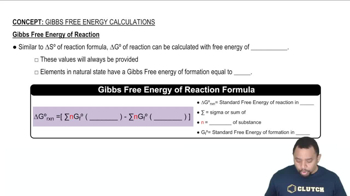
Gibbs Free Energy (ΔG)

Gibbs Free Energy (ΔG) is a thermodynamic potential that measures the maximum reversible work obtainable from a thermodynamic system at constant temperature and pressure. It is calculated using the equation ΔG = ΔH - TΔS, where ΔH is the change in enthalpy, T is the temperature in Kelvin, and ΔS is the change in entropy. A negative ΔG indicates that a reaction is spontaneous under the given conditions.
Video consigliato:
Percorso guidato
01:51
Gibbs Free Energy of Reactions

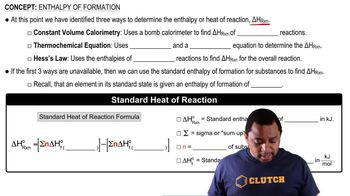
Enthalpy (ΔH)

Enthalpy (ΔH) is a measure of the total heat content of a system. It reflects the energy required to break and form bonds during a chemical reaction. A negative ΔH value, as in the given reaction, indicates that the reaction is exothermic, meaning it releases heat to the surroundings, which can favor spontaneity.
Video consigliato:
Percorso guidato
02:34
Enthalpy of Formation

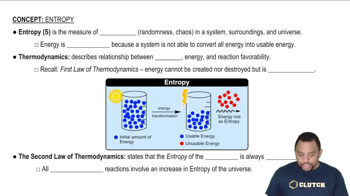
Entropy (ΔS)

Entropy (ΔS) is a measure of the disorder or randomness in a system. In thermodynamics, an increase in entropy is generally associated with the spontaneity of a process. A negative ΔS value, as provided in the question, suggests that the reaction leads to a decrease in disorder, which can hinder spontaneity unless compensated by a sufficiently negative ΔH at higher temperatures.
Video consigliato:
Percorso guidato
02:46
Entropy in Thermodynamics