
Ch.19 - Chemical Thermodynamics
Brown - Chemistry: The Central Science 14th Edition
Brown14th EditionChemistry: The Central ScienceISBN: 9780134414232Non è quello che usi tu?Cambia libro di testo
Capitolo 19, Problema 3b

b. If energy can flow in and out of the system to maintain a constant temperature during the process, what can you say about the entropy change of the surroundings as a result of this process?

Guida verificata passo dopo passo
1
Identify the type of system and process: The system allows energy exchange to maintain constant temperature, indicating it's an isothermal process.
Understand the concept of entropy: Entropy is a measure of the disorder or randomness in a system. In thermodynamics, it's also a measure of energy dispersal at a specific temperature.
Relate energy flow and entropy: When energy flows out of the system (as heat) to maintain constant temperature, it increases the entropy of the surroundings because the energy is dispersed into a larger environment.
Apply the second law of thermodynamics: This law states that the total entropy of an isolated system can never decrease over time. Since the system is not isolated but can exchange heat with its surroundings, the entropy of the surroundings must increase if the system's entropy decreases or remains constant.
Conclude about the entropy change of the surroundings: Since the system maintains a constant temperature by exchanging heat with its surroundings, and based on the second law of thermodynamics, the entropy of the surroundings increases as a result of this process.

Risposta video verificata per un problema simile:

Questa soluzione video è stata consigliata dai nostri tutor come utile per risolvere questo problema.
Durata del video:
3m

Concetti chiave

Ecco i concetti essenziali che devi comprendere per rispondere correttamente alla domanda.

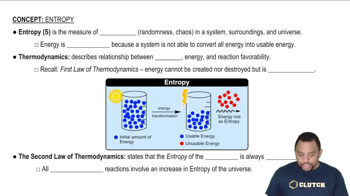
Entropy

Entropy is a measure of the disorder or randomness in a system. In thermodynamics, it quantifies the amount of energy in a physical system that is not available to do work. When energy is transferred between a system and its surroundings, the change in entropy can indicate whether the process is spontaneous or requires external energy input.
Video consigliato:
Percorso guidato
02:46
Entropy in Thermodynamics

Thermodynamic Equilibrium

Thermodynamic equilibrium occurs when a system's macroscopic properties, such as temperature and pressure, are uniform throughout and do not change over time. In the context of the question, maintaining a constant temperature implies that the system is in thermal equilibrium with its surroundings, allowing for energy exchange without a net change in temperature.
Video consigliato:
Percorso guidato
01:18
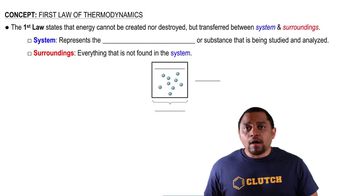
First Law of Thermodynamics

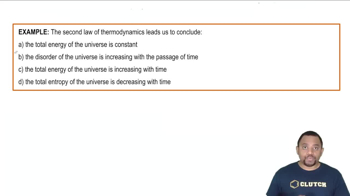
Second Law of Thermodynamics

The Second Law of Thermodynamics states that the total entropy of an isolated system can never decrease over time. It implies that processes occur in a direction that increases the total entropy of the universe. In the scenario described, if energy flows in and out of the system while maintaining constant temperature, the entropy change of the surroundings will increase, reflecting the energy exchange and the tendency towards greater disorder.
Video consigliato:
Percorso guidato
00:48
Second Law of Thermodynamics Example