
Ch.19 - Chemical Thermodynamics
Brown - Chemistry: The Central Science 14th Edition
Brown14th EditionChemistry: The Central ScienceISBN: 9780134414232Non è quello che usi tu?Cambia libro di testo
Capitolo 19, Problema 4

Predict the signs of ΔH and ΔS for this reaction. Explain your choice.

Guida verificata passo dopo passo
1
Understand the reaction: Identify if the reaction is endothermic or exothermic. If the reaction absorbs heat, ΔH is positive. If it releases heat, ΔH is negative.
Consider the states of matter: Determine the change in entropy (ΔS) by considering the states of the reactants and products. If the reaction results in more disorder (e.g., solid to gas), ΔS is positive. If it results in less disorder (e.g., gas to solid), ΔS is negative.
Analyze the reaction components: Look at the number of moles of gaseous reactants and products. An increase in the number of gas molecules typically indicates an increase in entropy (positive ΔS).
Consider the nature of the reaction: If the reaction involves breaking strong bonds and forming weaker ones, it might be endothermic (positive ΔH). Conversely, forming stronger bonds from weaker ones might be exothermic (negative ΔH).
Summarize your findings: Based on the analysis of heat exchange and disorder, predict the signs of ΔH and ΔS for the reaction.

Risposta video verificata per un problema simile:

Questa soluzione video è stata consigliata dai nostri tutor come utile per risolvere questo problema.
Durata del video:
3m

Concetti chiave

Ecco i concetti essenziali che devi comprendere per rispondere correttamente alla domanda.

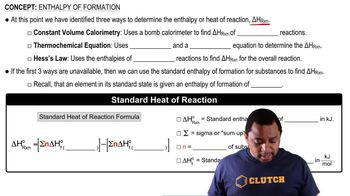
Enthalpy (ΔH)

Enthalpy (ΔH) is a measure of the total heat content of a system at constant pressure. It indicates whether a reaction is exothermic (releases heat, ΔH < 0) or endothermic (absorbs heat, ΔH > 0). Understanding the enthalpy change helps predict the energy flow during a chemical reaction.
Video consigliato:
Percorso guidato
02:34
Enthalpy of Formation

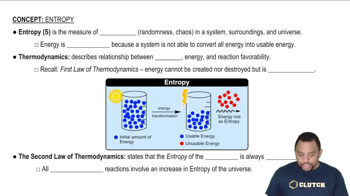
Entropy (ΔS)

Entropy (ΔS) is a measure of the disorder or randomness in a system. A positive ΔS indicates an increase in disorder, while a negative ΔS suggests a decrease in disorder. The change in entropy is crucial for predicting the spontaneity of a reaction, as reactions tend to favor higher entropy states.
Video consigliato:
Percorso guidato
02:46
Entropy in Thermodynamics

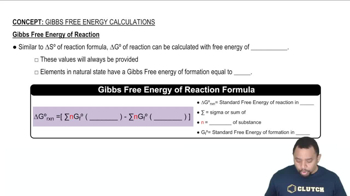
Gibbs Free Energy (ΔG)

Gibbs Free Energy (ΔG) combines enthalpy and entropy to determine the spontaneity of a reaction at constant temperature and pressure. The relationship ΔG = ΔH - TΔS helps predict whether a reaction will occur spontaneously (ΔG < 0) or not (ΔG > 0). Understanding this concept is essential for analyzing the thermodynamic favorability of reactions.
Video consigliato:
Percorso guidato
01:51
Gibbs Free Energy of Reactions