Ch.19 - Chemical Thermodynamics
Brown - Chemistry: The Central Science 14th Edition
Brown14th EditionChemistry: The Central ScienceISBN: 9780134414232Non è quello che usi tu?Cambia libro di testo
Capitolo 19, Problema 5c

The accompanying diagram shows how entropy varies with temperature for a substance that is a gas at the highest temperature shown. (c) If this substance is a perfect crystal at T = 0 K, what is the value of S at this temperature?

Guida verificata passo dopo passo
1
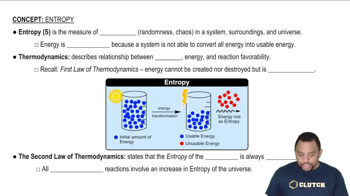
Identify the concept of entropy (S) and its relation to temperature. Entropy is a measure of the disorder or randomness in a system.
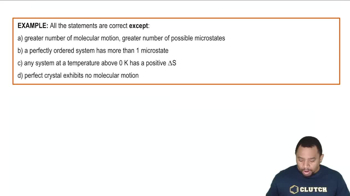
Recall the Third Law of Thermodynamics, which states that the entropy of a perfect crystal at absolute zero (0 K) is exactly zero.
Understand that a perfect crystal is a substance with a perfectly ordered structure, meaning there is only one possible microstate.
Apply the Third Law to the given problem: since the substance is a perfect crystal at T = 0 K, the entropy S at this temperature is zero.
Conclude that the value of S at T = 0 K for a perfect crystal is 0 J/K.

Risposta video verificata per un problema simile:

Questa soluzione video è stata consigliata dai nostri tutor come utile per risolvere questo problema.
Durata del video:
2m

Concetti chiave

Ecco i concetti essenziali che devi comprendere per rispondere correttamente alla domanda.

Entropy

Entropy is a measure of the disorder or randomness in a system. In thermodynamics, it quantifies the number of microscopic configurations that correspond to a thermodynamic system's macroscopic state. Higher entropy indicates greater disorder, while lower entropy suggests more order. Understanding entropy is crucial for analyzing the behavior of substances at different temperatures.
Video consigliato:
Percorso guidato
02:46
Entropy in Thermodynamics

Third Law of Thermodynamics

The Third Law of Thermodynamics states that as the temperature of a perfect crystal approaches absolute zero (0 K), the entropy of the crystal approaches a constant minimum, which is typically zero. This principle implies that at absolute zero, a perfect crystal has no disorder, and thus its entropy is zero. This law is fundamental in understanding the behavior of materials at low temperatures.
Video consigliato:
Percorso guidato
01:11
Third Law of Thermodynamics Example

Temperature and Phase Changes

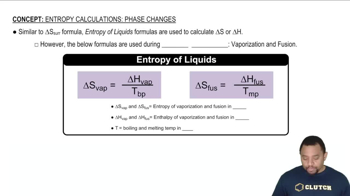
Temperature is a measure of the average kinetic energy of the particles in a substance. As temperature changes, substances can undergo phase changes, affecting their entropy. For gases, the entropy increases significantly with temperature due to increased molecular motion and disorder. Recognizing how temperature influences entropy is essential for interpreting thermodynamic diagrams and understanding the state of a substance.
Video consigliato:
Percorso guidato
01:46
Entropy in Phase Changes