Ch.19 - Chemical Thermodynamics
Brown - Chemistry: The Central Science 14th Edition
Brown14th EditionChemistry: The Central ScienceISBN: 9780134414232Non è quello che usi tu?Cambia libro di testo
Capitolo 19, Problema 25c

Indicate whether each statement is true or false. (c) In a certain spontaneous process the system undergoes an entropy change of 4.2 J/K; therefore, the entropy change of the surroundings must be -4.2 J/K.

Guida verificata passo dopo passo
1
insert step 1> Understand the concept of entropy and the second law of thermodynamics. Entropy is a measure of the disorder or randomness in a system, and the second law of thermodynamics states that the total entropy of an isolated system can never decrease over time.
insert step 2> Recognize that in a spontaneous process, the total entropy change (ΔS_total) of the universe (system + surroundings) must be greater than zero.
insert step 3> Identify that the given problem states the system undergoes an entropy change (ΔS_system) of 4.2 J/K.
insert step 4> Recall that the entropy change of the surroundings (ΔS_surroundings) is related to the heat exchange with the system and can be calculated using the formula ΔS_surroundings = -ΔS_system if the process is isothermal and reversible.
insert step 5> Evaluate whether the given statement that ΔS_surroundings must be -4.2 J/K is consistent with the requirement that ΔS_total = ΔS_system + ΔS_surroundings > 0 for a spontaneous process.

Risposta video verificata per un problema simile:

Questa soluzione video è stata consigliata dai nostri tutor come utile per risolvere questo problema.
Durata del video:
2m

Concetti chiave

Ecco i concetti essenziali che devi comprendere per rispondere correttamente alla domanda.

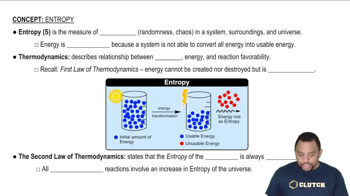
Entropy

Entropy is a measure of the disorder or randomness in a system. In thermodynamics, it quantifies the number of microscopic configurations that correspond to a thermodynamic system's macroscopic state. A positive change in entropy indicates an increase in disorder, while a negative change suggests a decrease. Understanding entropy is crucial for analyzing spontaneous processes, as they tend to favor states of higher entropy.
Video consigliato:
Percorso guidato
02:46
Entropy in Thermodynamics

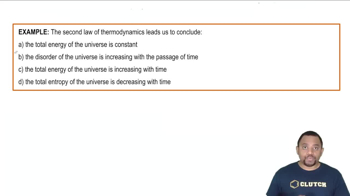
Second Law of Thermodynamics

The Second Law of Thermodynamics states that in any spontaneous process, the total entropy of an isolated system will always increase over time. This law implies that energy transformations are not 100% efficient, and some energy is always lost as heat, contributing to the overall increase in entropy. It also establishes the relationship between the entropy changes of the system and its surroundings, which is essential for evaluating the truth of statements regarding entropy changes.
Video consigliato:
Percorso guidato
00:48
Second Law of Thermodynamics Example

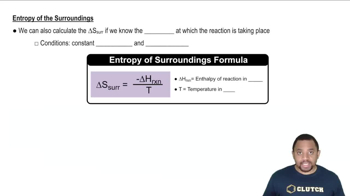
Entropy Change of the Surroundings

The entropy change of the surroundings is related to the heat exchanged with the system during a process. For a spontaneous process, the total change in entropy (system plus surroundings) must be positive. If a system experiences an entropy change of +4.2 J/K, the surroundings must experience a corresponding change that ensures the total entropy increases, which may not necessarily be -4.2 J/K, depending on the heat exchange and the nature of the process.
Video consigliato:
Percorso guidato
00:53
Entropy of Surroundings Formula