Ch.2 - Atoms, Molecules, and Ions
Brown - Chemistry: The Central Science 14th Edition
Brown14th EditionChemistry: The Central ScienceISBN: 9780134414232Non è quello che usi tu?Cambia libro di testo
Capitolo 2, Problema 66a

Which of the following are ionic, and which are molecular? (a) PF5

Guida verificata passo dopo passo
1
Identify the types of elements involved in the compound. Phosphorus (P) is a non-metal, and Fluorine (F) is also a non-metal.
Recall that ionic compounds are typically formed between metals and non-metals, while molecular (or covalent) compounds are formed between non-metals.
Since both phosphorus and fluorine are non-metals, the compound PF_5 is likely to be a molecular compound.
Consider the nature of the bond: In molecular compounds, atoms share electrons to form covalent bonds.
Conclude that PF_5 is a molecular compound because it consists of non-metal elements forming covalent bonds.

Risposta video verificata per un problema simile:

Questa soluzione video è stata consigliata dai nostri tutor come utile per risolvere questo problema.
Durata del video:
7m

Concetti chiave

Ecco i concetti essenziali che devi comprendere per rispondere correttamente alla domanda.

Ionic vs. Molecular Compounds

Ionic compounds are formed when electrons are transferred from one atom to another, resulting in the formation of charged ions that attract each other due to electrostatic forces. In contrast, molecular compounds are formed when atoms share electrons through covalent bonds. Understanding the distinction between these two types of compounds is essential for classifying substances correctly.
Video consigliato:
Percorso guidato
02:11
Ionic Compounds Naming

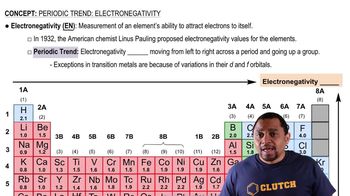
Electronegativity

Electronegativity is a measure of an atom's ability to attract and hold onto electrons in a bond. In ionic compounds, there is a significant difference in electronegativity between the atoms involved, typically greater than 1.7, leading to electron transfer. For molecular compounds, the difference is usually smaller, resulting in shared electrons. This concept helps determine whether a compound is ionic or molecular.
Video consigliato:
Percorso guidato
02:10
Electronegativity Trends

Lewis Structures

Lewis structures are diagrams that represent the bonding between atoms in a molecule and the lone pairs of electrons that may exist. They are useful for visualizing the arrangement of atoms and the type of bonds (ionic or covalent) present in a compound. Drawing Lewis structures can help identify whether a compound like PF5 is molecular, as it shows how the atoms are connected and share electrons.
Video consigliato:
Percorso guidato
04:28
Lewis Dot Structures: Ions